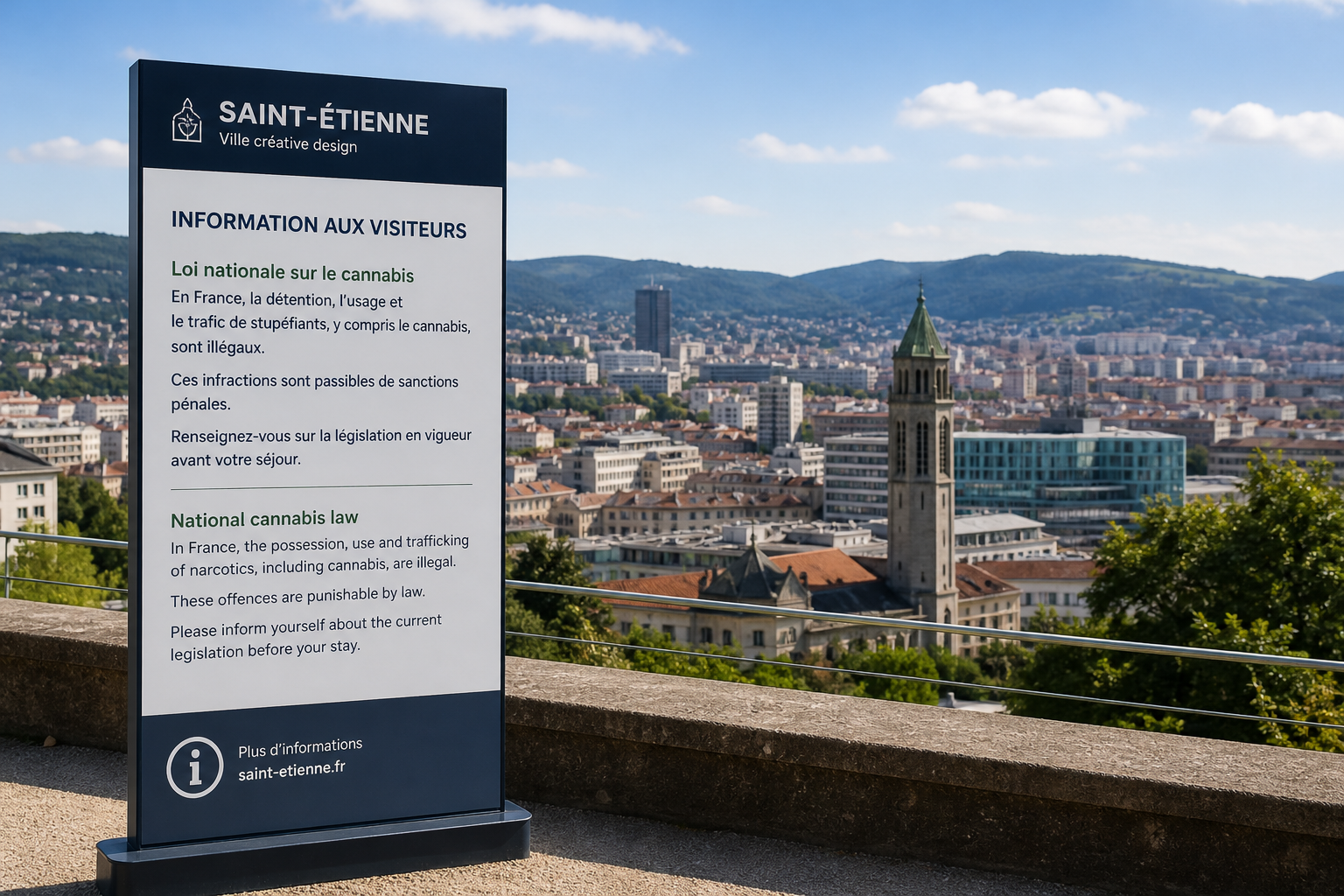
Understanding Cannabis policy in Saint-Étienne starts with one important point: the city follows French national drug law. Saint-Étienne does not have a separate recreational cannabis market or a local system of licensed cannabis shops. Possession, purchase, sale, transport and use of illicit cannabis remain prohibited, although the response to a minor personal-use offence may differ from the response to trafficking or repeat offending.
This guide explains how the rules affect residents and visitors, what is different about CBD, why driving deserves particular caution and where to find reliable help. It is general information rather than legal advice. French rules and enforcement procedures can change, so anyone facing a police investigation or court case should consult a qualified French lawyer.
Cannabis laws in Saint-Étienne under French national law
French law treats cannabis containing prohibited levels of THC as a controlled narcotic. The basic legal position is the same in Saint-Étienne as in Lyon, Marseille, Paris and other French cities. A person cannot legally buy recreational cannabis from a licensed storefront, carry it for personal use or consume it in a public place.
The practical consequences depend on the conduct, quantity, evidence and circumstances. Simple personal use can be handled through an administrative-style fixed criminal fine in appropriate cases, while more serious matters may proceed through a prosecutor or court. An allegation involving supply, importation, cultivation, organised activity or significant quantities can expose someone to substantially more serious criminal consequences.
The official French government information on drug use and penalties explains the general legal framework. It should be read alongside any paperwork issued by police, prosecutors or a court, because the exact procedure depends on the case.
Possession, use and the fixed fine
For some cases of drug use, French authorities may issue a fixed fine rather than immediately taking the matter through a full trial. The commonly cited amount for the standard fixed fine for narcotics use is €200, with a lower amount for prompt payment and a higher amount when payment is late. This is not a universal substitute for prosecution: the procedure may not apply in every situation, and the facts can lead to a different response.
Refusing to identify yourself, disputing the facts, failing to pay or being involved in other offences can create additional legal complications. A fine also does not make possession or consumption lawful. Visitors should not assume that a small amount is automatically ignored or that a foreign passport prevents enforcement.
Public consumption and local enforcement
Using cannabis in a street, park, station area, vehicle or other public setting can attract police attention and create additional public-order concerns. Saint-Étienne includes busy transport areas, residential neighbourhoods, university spaces and nightlife districts where officers may respond to smoke, complaints or disruptive behaviour. Local priorities can affect visibility of enforcement, but they do not change the underlying national prohibition.
Do not treat a quiet location as a legal exception. A private setting may reduce the chance of a public-order complaint, but it does not legalise the possession or use of illicit cannabis. Sharing cannabis with another person can also raise questions about supply, even when no money changes hands.
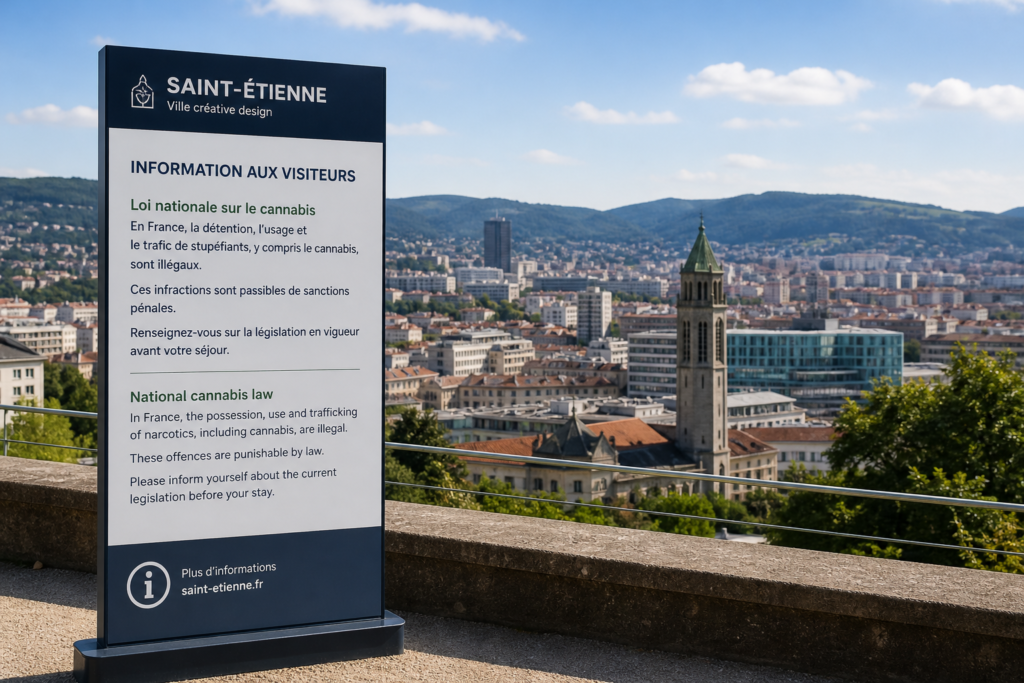
Weed in Saint-Étienne: buying, carrying and selling risks
Searching for weed in Saint-Étienne can expose a person to more than the risk of possessing cannabis. Buying from an informal seller means the product may be mislabelled, contaminated or unusually potent. There is also no reliable consumer protection, age verification or quality control in an illicit transaction.
Carrying cannabis across France or across an international border is especially risky. Border checks, transport hubs and police investigations can turn a possession matter into a more serious inquiry about importation or supply. Do not take cannabis on a train, coach, flight or road journey, and never assume that a product bought legally in another country can be brought into France.
- Possession: may lead to a fixed fine, seizure, investigation or prosecution depending on the circumstances.
- Purchase: creates both possession risk and exposure to an illicit supply chain.
- Sharing or selling: may be treated more seriously than private use.
- Growing plants: is not a general recreational exception and can lead to criminal consequences.
- Transport across borders: can create severe additional risks, even for a small amount.
For a broader comparison of how French rules apply in another city, see this guide to cannabis regulations in Reims. The same national framework generally applies, although the local context and policing experience may differ.
CBD in Saint-Étienne: legal does not mean unrestricted
CBD products are not automatically equivalent to recreational cannabis. In France, products marketed as CBD must comply with applicable rules, including requirements concerning authorised hemp varieties and THC content. A product sold as CBD should not be assumed to be legal simply because it is displayed in a shop or purchased online.
Consumers should check the product category, labelling, ingredients and testing information. Oils, flowers, resins, food products and vaping liquids may have different regulatory considerations. Some products can contain enough THC to create legal or employment problems, especially where testing is involved.
CBD can also cause confusion during roadside screening. A CBD product may be advertised as non-intoxicating, yet a product containing trace THC may still create a risk of a positive test. The safest approach for anyone who must drive, operate machinery or comply with workplace testing is to obtain professional advice and avoid uncertain products.
Our related guide on CBD in Lyon and French safety considerations provides additional national context. It is not a guarantee that every product sold in a particular shop meets legal requirements.
Medical cannabis in Saint-Étienne
Medical cannabis in Saint-Étienne is not the same as buying recreational cannabis or self-medicating with a CBD product. French access to cannabis-based treatment has developed through tightly controlled medical and regulatory arrangements rather than an open dispensary model. Eligibility, products, prescribing rules and reimbursement can depend on the current national framework and the patient’s medical situation.
Patients should speak with their treating doctor, specialist or pharmacist about approved treatments and alternatives. Do not substitute an illicit product for prescribed medicine, stop another treatment without medical advice or assume that a foreign prescription automatically permits possession in France.
People travelling with a cannabis-based medicine should verify French import and documentation requirements before departure. Packaging, a prescription and a medical letter may be relevant, but documents do not necessarily authorise every product or quantity. Contacting the relevant French authorities or a consulate before travel is safer than relying on informal online advice.
Cannabis and driving around Saint-Étienne
Driving after using cannabis is a major legal and safety risk. France applies a strict approach to drug-impaired driving, and roadside testing can lead to further testing and criminal proceedings. The issue is not simply whether a driver feels intoxicated. A positive test for a prohibited substance can be sufficient for enforcement, subject to the applicable procedure and evidence.
This matters in and around Saint-Étienne, including journeys on urban roads, motorways and routes connecting the city with the wider Loire area. Do not drive after using cannabis, and do not get into a vehicle with a driver who may be impaired. Arrange a sober driver, use public transport or take a taxi or rideshare instead.
Drug-driving consequences can include licence measures, fines, court proceedings and difficulties involving insurance or employment. Combining cannabis with alcohol increases impairment risk and makes a safe journey even less likely.
Health and personal safety considerations
Legal risk is only part of the picture. Cannabis can affect attention, reaction time, memory and coordination. Effects vary with THC strength, dose, experience, method of consumption, other substances and individual health. Edibles can be particularly difficult to judge because effects may take longer to appear and last longer than expected.
- Do not mix cannabis with alcohol, sedatives or other drugs.
- Do not drive, cycle in traffic, swim or operate machinery after use.
- Avoid consuming an unknown product or an unexpectedly strong dose.
- People with a history of psychosis, severe anxiety or cardiovascular problems should seek medical advice before considering cannabis exposure.
- Keep cannabis products away from children and pets.
If someone becomes severely confused, unconscious, has chest pain, experiences a seizure or appears in immediate danger, call French emergency services on 15 or 112. For prevention information and support resources, the French government’s official drugs information portal is a useful starting point.
What residents and visitors should do
If approached by police
Remain calm, do not resist and follow lawful instructions. Ask what procedure is being used and request an interpreter if you do not understand French well enough to protect your interests. Do not sign a document you cannot understand. If the matter is more serious than a simple fixed fine, or if you are detained, ask about contacting a lawyer and your consulate where appropriate.
If you receive a fine
Read the notice carefully, check the payment deadline and keep proof of payment or any challenge submitted. Paying may have legal consequences, while ignoring the notice can increase the amount or lead to further action. If you believe the facts are wrong, obtain legal advice promptly rather than relying on an online summary.
If you are travelling
Do not carry illicit cannabis into Saint-Étienne, between French cities or across a national border. Avoid transporting uncertain CBD products, especially flowers, resins or products with unclear THC information. Prescription medicines should remain in original packaging and be supported by documentation checked in advance.
Conclusion
Cannabis in Saint-Étienne is governed primarily by French national law, not by a city-level recreational legalisation scheme. Personal use and possession remain prohibited, informal sales carry serious risks, CBD must meet applicable requirements and medical access is controlled. Driving after cannabis use is particularly dangerous because enforcement can follow a positive test even when a driver believes the effects have ended.
The safest practical approach is straightforward: do not buy or carry illicit cannabis, do not use it in public, do not drive after exposure and obtain medical or legal advice from a qualified professional when circumstances are unclear. Check current official guidance before acting, especially when travelling with a medicine or CBD product.