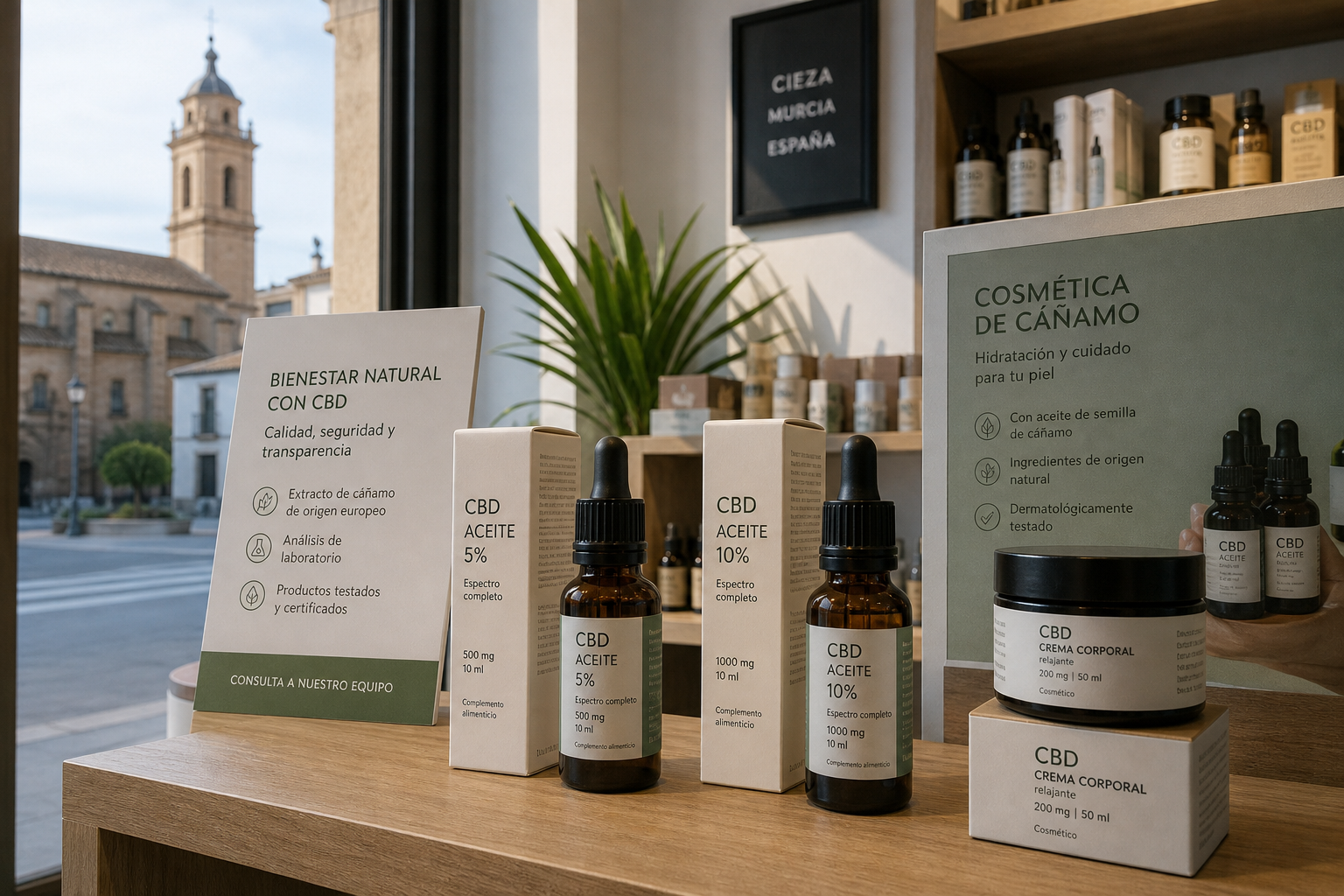
Understanding CBD legality in Cieza means separating cannabidiol from recreational cannabis and then checking how Spanish rules apply to the specific product. CBD itself is not generally treated in the same way as THC, the intoxicating cannabinoid. However, a product’s ingredients, THC content, intended use, labelling and sales channel can all affect whether it may be lawfully marketed or used.
Cieza is in the Region of Murcia, but the main rules governing CBD are Spanish and European rather than a special local cannabis code. This guide explains the practical position without assuming that every oil, flower, edible or vape sold under the CBD label has the same legal status. Rules and enforcement can change, so consumers should verify current information before purchasing, travelling or using a product.
What CBD legality in Cieza means in practice
CBD is a non-intoxicating cannabinoid found naturally in hemp and cannabis plants. A product containing CBD is not automatically legal simply because it does not produce a high. Authorities may also consider whether it contains THC, whether it is intended for human consumption, whether it makes medical claims and whether it complies with product-safety and labelling requirements.
For most consumers, the key distinction is between hemp-derived products sold for permitted uses and products marketed as food, supplements or medicines without the necessary authorisation. The label “CBD” is not a legal guarantee. A compliant-looking package can still be unsuitable for sale if its formulation or marketing falls outside the applicable rules.
National rules apply in Cieza
There is no general Cieza licence that makes ordinary recreational cannabis sales legal. Local businesses must comply with Spanish rules on controlled substances, consumer protection, cosmetics, food, medicines, advertising and commercial activity. Municipal authorities may also address premises, signage, licences, nuisance or public-order issues, but those local matters do not replace national product law.
This is why CBD laws in Cieza should be understood as Spanish CBD rules applied in a local setting. A shop’s presence on a high street does not by itself prove that every product in the shop is authorised or lawful for every intended use.
THC limits and why the product category matters
THC is usually the most important legal risk marker. Hemp varieties used for lawful industrial purposes must meet applicable THC requirements, and products placed on the market must not be assumed compliant merely because they are described as hemp-based. Consumers should check the product’s certificate of analysis, batch information and manufacturer details rather than relying only on front-of-pack claims.
Even where a product contains only trace THC, its legal treatment can depend on its form and purpose. A topical cosmetic, a scented hemp item, a food product and a vape liquid are not regulated in exactly the same way.
- Topical cosmetics: Creams, balms and similar products may be treated under cosmetics rules if their ingredients, safety file, labelling and claims comply with those rules.
- Foods and supplements: CBD added to food or sold as an ingestible supplement raises separate authorisation issues. Consumers should not assume that an oil sold in a shop is approved as a food or medicine.
- Vape products: Vaping products can trigger rules on ingredients, safety, packaging, advertising and nicotine-related or tobacco-related product controls, depending on the formulation and presentation.
- CBD flowers: Flowers can create particular uncertainty because they resemble cannabis, may contain variable THC levels and are often promoted for inhalation even when labelled for another purpose.
- Medical products: A product making therapeutic claims may require medicines authorisation. A retail CBD product is not automatically a prescription treatment.
The European Commission maintains an official Union list of authorised novel foods. It is a useful reference for understanding why the sale of ingestible CBD products cannot be assessed by looking at THC content alone.
Are CBD oils and edibles legal in Cieza?
Many people searching for buying CBD in Cieza are looking for oils, capsules, gummies or drinks. The important question is not only whether the item contains CBD, but whether it is lawfully authorised for the way it is being sold and used.
CBD oils marketed as cosmetics or for external use may be treated differently from oils promoted for swallowing. Product wording matters: instructions, dosage guidance, disease claims and references to anxiety, pain, insomnia or epilepsy can move a product toward the regulatory territory of food supplements or medicines. Consumers should be cautious when a seller promises treatment or presents CBD as a substitute for prescribed care.
Edibles deserve particular caution. Gummies, chocolates, drinks and capsules are intended for ingestion, and their sale may involve novel-food and food-safety requirements. A product being available online or displayed in a local shop does not establish that it has the required authorisation. If the packaging is unclear about ingredients, responsible business details, batch testing or intended use, avoiding the product is the safer decision.
CBD flowers, smoking and public use
CBD flowers are one of the most confusing areas of CBD products in Cieza. Some sellers describe them as aromatic or collectible hemp products rather than products for smoking. That wording does not eliminate practical risks. The flowers may be mistaken for cannabis, may produce an unpleasant interaction with police or venue staff, and may contain more THC than the buyer expects.
Even if a flower product is marketed as legal hemp, smoking it in a public place can create separate problems involving public order, smoke restrictions, nuisance or the possession of a substance that officers cannot immediately identify. Carrying loose flowers without original packaging and testing information is especially unwise.
Spain’s public-security framework allows sanctions for certain unlawful possession or consumption of drugs in public places. The official text of Organic Law 4/2015 on public security should be consulted for the legal framework, while current professional advice may be appropriate in a disputed case. A CBD label should not be treated as protection against every possession or public-use issue.
Buying CBD in Cieza: a practical checklist
A careful buyer can reduce risk by treating CBD as a regulated consumer product rather than an unregulated wellness item. Before paying, check the following:
- Read the complete ingredient list and confirm whether the product is intended for external use, inhalation or ingestion.
- Look for a recent batch-specific certificate of analysis from an identifiable laboratory.
- Check the stated THC result and whether the report identifies the same product and batch.
- Confirm that the packaging names a responsible manufacturer or importer and provides traceability information.
- Be wary of claims that the product cures, prevents or treats a medical condition.
- Ask the seller what regulatory category the item belongs to and whether it is authorised for the proposed use.
- Keep the product in its original sealed packaging, especially when travelling or carrying it outside the home.
These steps cannot turn an unauthorised product into a lawful one, but they can help identify misleading labelling and reduce avoidable uncertainty. A seller who cannot explain the product category or provide basic traceability information is a reason to walk away.
Travelling with CBD from Cieza
Travel creates additional uncertainty because rules and enforcement can differ between countries. A product that can be sold for a particular purpose in Spain may not be accepted elsewhere, particularly if it contains THC, is presented as a medicine or is carried in a form associated with cannabis.
For domestic travel, keep any product sealed, labelled and accompanied by its receipt or batch documentation. Do not transfer CBD oil into an unmarked container. For international travel, check the destination country’s official rules before departure and consider leaving CBD at home if the position is unclear. Airport security and border authorities may test or confiscate products even when a buyer believes they are compliant.
People using a prescribed cannabinoid medicine should carry the prescription and supporting medical documents and obtain country-specific advice. A general retail CBD product is not equivalent to a prescribed medicine.
Medical use and health considerations
Consumers in Cieza should distinguish between a retail CBD product and a regulated medical treatment. CBD may interact with medicines and may cause adverse effects, including drowsiness or gastrointestinal symptoms. Product quality can also vary, particularly where independent testing is absent.
Anyone taking prescription medicines, managing liver disease, pregnant or breastfeeding, or considering CBD for a child should consult a qualified healthcare professional before use. Do not stop or replace prescribed treatment because a product label makes a therapeutic claim.
Medical cannabis access and prescribing are separate from the ordinary retail sale of CBD. If a clinician believes cannabinoid treatment may be appropriate, the patient should follow the authorised medical route rather than relying on an online seller’s diagnosis or dosage advice.
How Cieza residents can respond to a problem
If a product appears misleading, unsafe or incorrectly labelled, keep the packaging, receipt, photographs and batch number. Start by asking the seller for a written explanation and documentation. If the issue concerns consumer information or a sale, a local consumer-information service or the relevant regional authority may be able to explain the complaint route.
If someone is stopped or fined over a product believed to be CBD, they should avoid making assumptions about the outcome. The exact contents, setting, documentation and officer’s findings may matter. A qualified Spanish lawyer can assess a seizure, sanction notice or allegation more reliably than general internet guidance.
For broader background, readers may also find this guide to CBD shops and legal buying considerations in Manacor useful for comparison, although local availability and enforcement should not be treated as identical to Cieza. Related explanations of marijuana restrictions in Torre-Pacheco can also help clarify why municipal context does not replace Spanish national law.
Conclusion
CBD is not automatically illegal in Cieza, but neither is every product carrying a CBD label automatically lawful. The safest analysis considers THC content, product format, intended use, claims, labelling and authorisation. Topical products may follow a different route from ingestible oils, edibles, flowers or medical preparations.
For residents and visitors, the practical approach is straightforward: buy only products with clear traceability, avoid unsupported medical claims, treat CBD flowers and public use with particular caution, and check official or professional guidance when the situation is uncertain. That approach is more reliable than assuming that a shop display, online listing or “legal hemp” label settles the question.