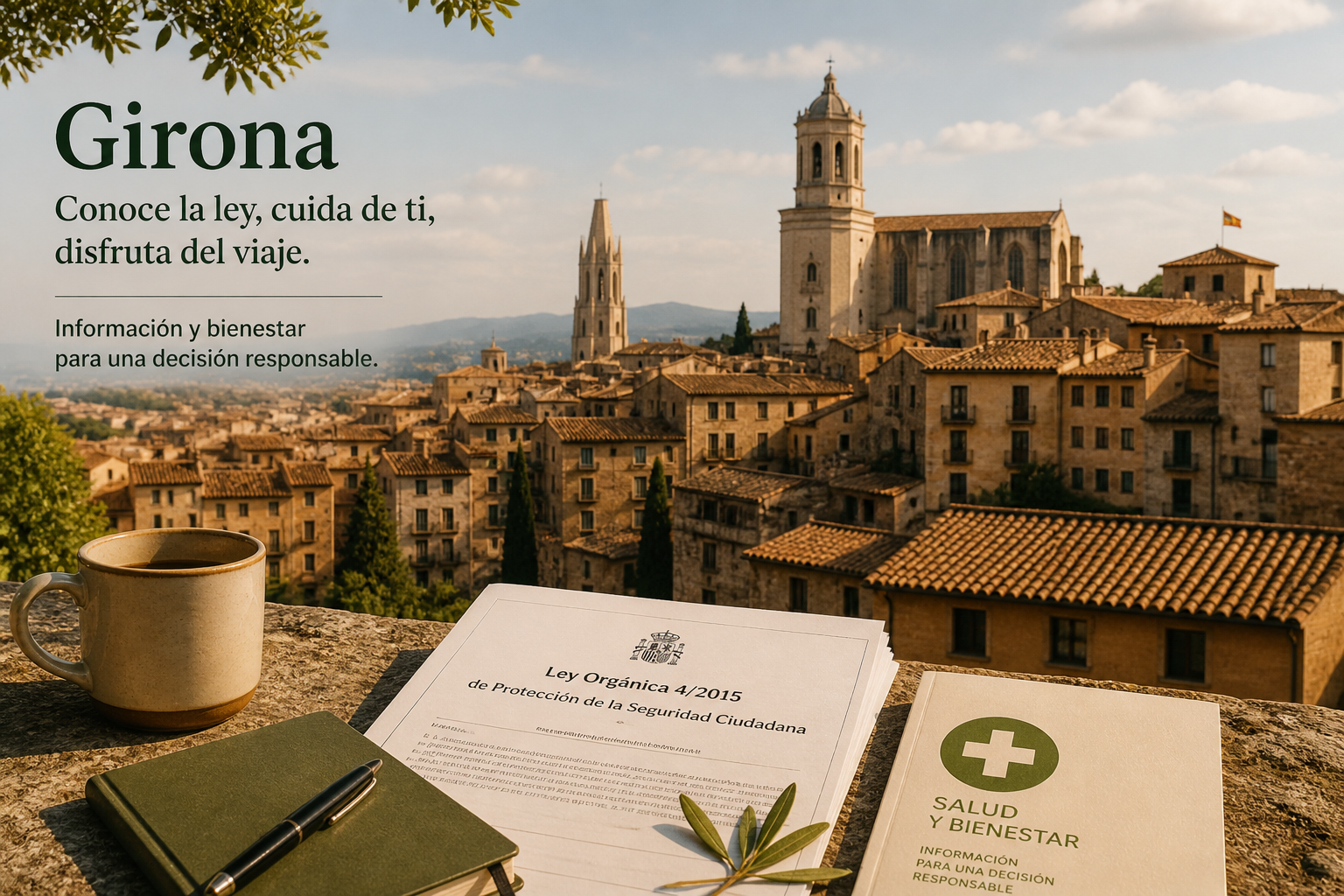
Understanding Cannabis facts about Girona requires separating Spanish law from popular assumptions about private consumption, cannabis clubs, CBD products and medical treatment. Girona is a historic Catalan city and a useful base for exploring the Costa Brava, but visitors and residents are still subject to Spain’s national drug laws, regional health rules and local public-space regulations.
This guide explains what the law generally means in practice, why public consumption can create serious problems, how travel affects risk, and where to look for reliable health information. It does not replace advice from a Spanish lawyer, doctor or public authority. Rules and enforcement can change, so check current official information before making decisions.
Cannabis laws in Girona: the national framework
There is no separate recreational cannabis market created by Girona’s city government. The main legal framework comes from Spain’s national legislation, including criminal law and the law on the protection of public security. Catalan institutions and Girona authorities may also influence health services, local enforcement and municipal rules, but they cannot turn ordinary retail cannabis sales into a generally licensed activity.
Spain’s system is often described as tolerant, but that description is incomplete. Personal conduct in a genuinely private setting is treated differently from possession or use in public, supply to another person, cultivation intended for distribution, or conduct that creates a public-safety issue. The details and circumstances matter.
The official text of Spain’s public-security law identifies illicit possession or use of drugs in public places, public establishments or collective transport as an administrative offence, even where the substance is not intended for sale. This is an important distinction for anyone walking through Girona, waiting at a station or staying in a hotel with shared areas.
Public possession and consumption
Possessing or consuming cannabis in a public place can lead to an administrative sanction. The law provides a framework for serious offences with fines that can range from 601 to 30,000 euros, depending on the classification and circumstances. A specific outcome depends on the facts, the evidence, the authority involved and any applicable procedure; the maximum figure should not be interpreted as the normal result of every incident.
Police may also seize suspected cannabis and record personal details during an investigation. Public disorder, driving concerns, proximity to sensitive locations or indications of supply can make an incident more serious. Do not assume that a small quantity automatically makes public possession acceptable.
Supply, sale and trafficking
Selling, distributing or facilitating access to cannabis can create criminal liability. Sharing cannabis is not automatically risk-free, particularly when money, organized activity, repeated conduct or harm to others is involved. Importing or exporting cannabis is also legally risky, including when a person believes the quantity is for personal use.
Crossing the Spanish border with cannabis is especially unwise. Airport, rail, road and customs controls operate independently of any private-consumption argument. A product purchased elsewhere may also have a different legal status, label or composition than expected.
Private use and cannabis clubs in Girona
Spanish law does not create a simple nationwide recreational retail system. In some parts of Spain, private cannabis associations have operated under legal theories based on private, closed membership and collective consumption. That history is sometimes presented as proof that cannabis clubs are fully legal. It is not.
The legal position of an association depends on its organization, location, membership, premises, conduct and interpretation by authorities and courts. A club’s existence is not a guarantee that every activity inside it is lawful, and membership does not give a visitor permission to consume in public or transport cannabis around the country.
Anyone considering an association should be cautious about claims such as “legal for tourists,” “no limits” or “safe to carry anywhere.” Ask whether the organization has transparent rules, age checks, responsible conduct policies and clear information about local requirements. Avoid any operation that encourages public use, resale, driving after consumption or taking cannabis across a border.
For broader context on regional travel considerations, readers can compare this guide with information about cannabis laws for travelers in Reus. Nearby cities may share national rules while differing in enforcement priorities and local practicalities.
Medical cannabis in Girona
Medical cannabis should not be confused with recreational access. A person who uses cannabis to manage pain, nausea, sleep problems or another condition should discuss the issue with a qualified healthcare professional rather than self-medicating. Cannabis can affect attention, memory, coordination, mood and heart rate, and it can interact with medicines or worsen some mental-health conditions.
Access to cannabis-based medicines depends on the product, indication, prescribing route and current Spanish healthcare rules. A product obtained informally is not equivalent to a prescribed medicine: its strength, contaminants and cannabinoid balance may be unknown. Visitors should not assume that a prescription from another country automatically permits possession or use in Spain.
People receiving treatment should carry medicines in original packaging, retain relevant prescription documentation and verify travel requirements before departure. A pharmacist, doctor or Spanish health authority can explain whether a particular medicine is recognized and how it should be transported.
For general information on the health risks and evidence surrounding cannabis, the European Union Drugs Agency provides research-based resources on cannabis, drug use and public health. Health information online should support, not replace, an individual clinical assessment.
CBD in Girona: not the same as intoxicating cannabis
CBD products are often marketed as a gentler alternative, but “CBD” does not automatically mean unrestricted or risk-free. A product may contain trace amounts of THC, fail to match its label or be classified differently depending on its ingredients, intended use and method of sale.
Food, cosmetics, supplements, flowers, oils and medicines can fall under different regulatory approaches. A product sold in a shop is not necessarily legal to consume in every setting, and “THC-free” claims should be checked rather than assumed. Some screening tests may also create complications if a product contains more THC than stated.
When evaluating CBD in Girona, look for clear labelling, batch information, ingredients and a reputable seller. Do not use unverified products before driving, working at height, operating machinery or undergoing a drug test. If you take prescription medicines, ask a healthcare professional about possible interactions.
Travel and personal safety in Girona
Girona’s compact old town, transport connections and proximity to international travel routes make practical safety especially important. Cannabis-related problems often arise not from private beliefs about consumption, but from public visibility, impaired decisions, possession during travel or conflict with accommodation rules.
- Do not drive after using cannabis. Psychoactive effects can impair reaction time and judgment, while Spanish road enforcement may create separate legal consequences.
- Never carry cannabis across an international border. This includes airport luggage, road trips and rail journeys into France or another country.
- Keep private matters private. Avoid use in streets, beaches, parks, plazas, station areas, balconies visible to the public and shared accommodation spaces.
- Respect hotel and rental policies. A landlord or host may prohibit smoking, vaporizing or possession on the premises even when no criminal offence is involved.
- Do not accept packages or transport items for someone else. You may not know what they contain, and responsibility can become complicated quickly.
- Seek help for an adverse reaction. Severe anxiety, chest pain, confusion, fainting, hallucinations or difficulty breathing requires urgent medical attention.
Intoxication can also increase vulnerability to theft, falls, unwanted sexual contact and poor decisions. Stay with trusted companions, keep access to your phone and identification secure, and avoid combining cannabis with alcohol or other drugs.
Health facts worth knowing before using cannabis
Cannabis affects people differently. THC can produce euphoria and relaxation, but it may also cause anxiety, paranoia, drowsiness, impaired coordination and rapid heart rate. Stronger products and edible products can create delayed or unexpectedly intense effects. Edibles may take much longer to feel than inhaled cannabis, which increases the risk of consuming more than intended.
Regular use can become difficult to control for some people. Warning signs include using more than planned, prioritizing cannabis over work or relationships, continuing despite harm and experiencing cravings or withdrawal symptoms. Adolescents, pregnant people and those with a personal or family history of psychosis should be especially cautious and seek professional advice.
Lower-risk choices include avoiding use altogether when driving or responsible for another person, not mixing substances, choosing a trusted environment and stopping if uncomfortable symptoms appear. No method eliminates risk, and uncertain product strength makes self-management harder.
How Girona visitors can check current rules
Legal information changes, and online discussion can be misleading. Before travelling, consult official Spanish or Catalan public-health and legal sources, your consulate where appropriate, and a qualified professional for personal circumstances. Check transport rules separately from possession rules: an activity may be treated differently in a private residence, a hotel, a train, an airport or across a border.
It is also useful to distinguish an administrative penalty from a criminal investigation. Both can be disruptive, but they involve different processes and consequences. If police stop you, remain calm, avoid arguing in public and request professional legal assistance if you are unsure about your rights or the allegation.
Travelers looking at Catalonia more broadly may also find practical context in this guide to cannabis services and regulations in Lleida. The comparison is useful, but local information should never be treated as permission to carry or consume cannabis in Girona.
Key takeaways about cannabis in Girona
- Spain does not have a general legal retail market for recreational cannabis.
- Public possession or use can result in seizure and an administrative sanction.
- Sale, distribution, importing and exporting can create much more serious legal exposure.
- Cannabis clubs operate in a legally complex area and are not a guarantee of unrestricted access.
- Medical products and CBD products follow different rules from informal recreational cannabis.
- Driving, public use and international travel create avoidable risks.
- Official sources and qualified professionals are more reliable than social-media claims.
Conclusion
The most useful cannabis facts about Girona are practical: national Spanish law applies, public use and possession can be sanctioned, cannabis clubs are not a blanket legalization scheme, and medical or CBD products require careful attention to their specific rules. Visitors should also treat driving, accommodation, public spaces and border crossings as separate risk areas.
A cautious approach is straightforward: verify current information, avoid public consumption, never drive impaired, do not cross borders with cannabis, and seek professional health or legal advice when the situation is personal or uncertain. Responsible choices reduce both legal exposure and avoidable health risks while allowing travelers to enjoy Girona safely.