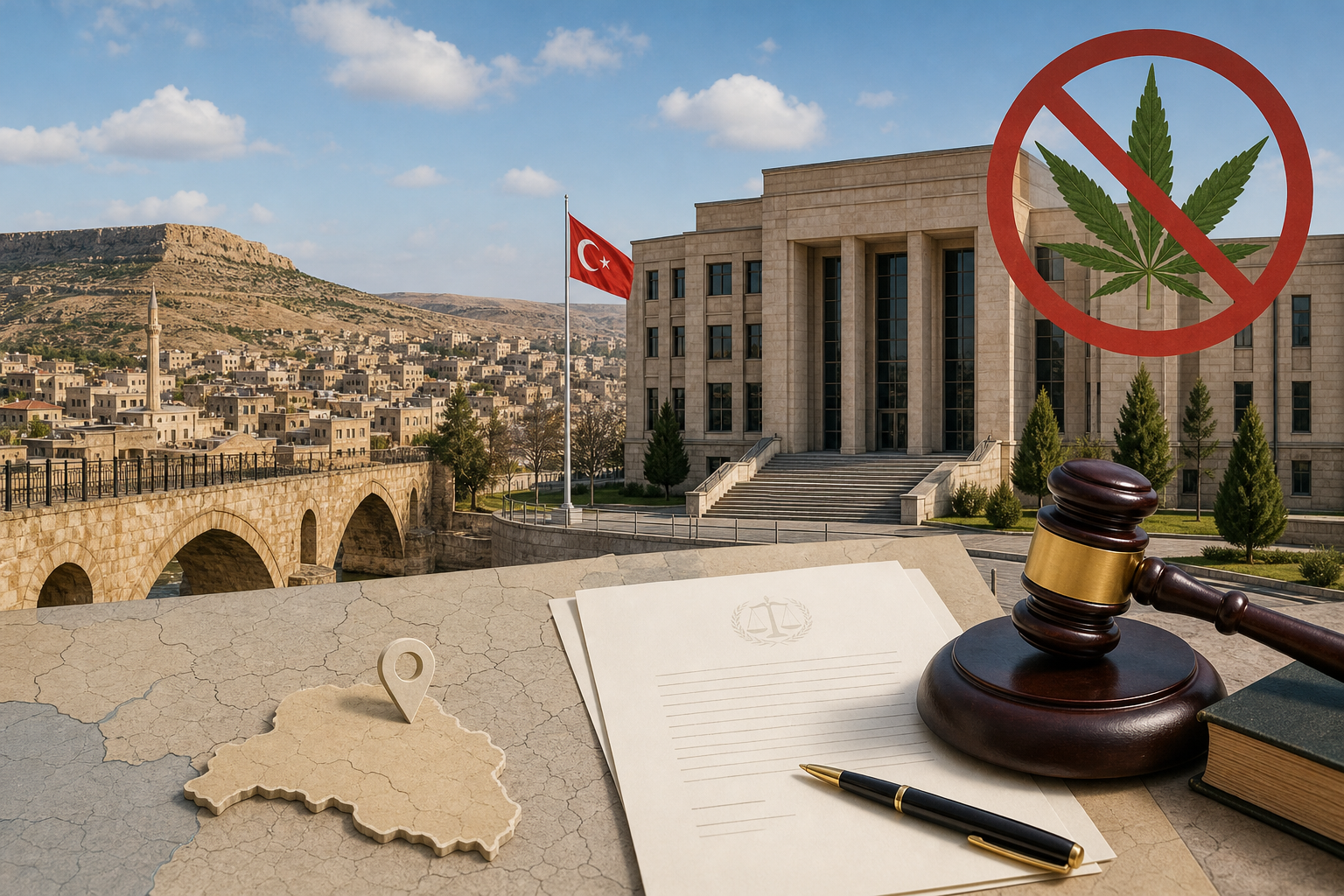
Understanding Cannabis possession laws in Kızıltepe requires looking at Turkish national law rather than assuming that local customs or practices determine legality. Kızıltepe is a district of Mardin Province, but possession, personal use, supply and cultivation are principally governed by Turkey’s national criminal legislation. Police and prosecutors may treat a suspected cannabis matter seriously even when the amount appears small.
This guide explains the legal distinctions that commonly matter, what can happen after a search or arrest, and how residents and visitors can respond safely. It is general information, not legal advice. Anyone facing questioning, detention or a criminal investigation should contact a qualified Turkish criminal lawyer promptly.
Cannabis laws in Kızıltepe are based on Turkish national law
There is no separate Kızıltepe cannabis code that permits conduct prohibited elsewhere in Turkey. The same national framework applies in Kızıltepe, nearby districts and the wider Mardin region. Local police, prosecutors and courts enforce those rules, while the facts of each case determine how authorities characterize the conduct.
Turkey’s Penal Code distinguishes between personal use or possession connected with use and more serious conduct such as supplying, selling, transporting for distribution or organizing drug activity. The relevant provisions include rules concerning the purchase, acceptance, possession and use of drugs, as well as separate provisions for manufacturing, importing, exporting and trafficking.
For the official text of Turkish legislation, consult the Turkish legislation database. Because legal texts and administrative practice can change, the current wording should be checked before relying on any summary.
What possession can mean in practice
In ordinary language, possession may mean having cannabis in a pocket, bag, vehicle, home or another place under a person’s control. In a legal investigation, however, authorities may examine physical control, knowledge, ownership, the location of the substance and the surrounding evidence. A person does not necessarily avoid risk merely because the cannabis belongs to somebody else or is stored in a shared space.
Authorities may also investigate whether a person acquired, accepted or used cannabis. The quantity alone is not a complete answer. A small amount can still lead to investigation, and a larger amount, packaging, messages, scales, cash, repeated transactions or witness statements may cause authorities to examine whether the matter involves supply rather than personal use.
Personal use and possession connected with use
Turkish law can treat possession for personal use differently from commercial drug offenses, but that distinction does not make possession lawful. A person may still be detained, questioned and investigated. Depending on the circumstances and the prosecutor’s assessment, the process may involve supervision, treatment-related measures or criminal proceedings.
It is unsafe to assume that a first allegation will simply be ignored or that a person can resolve the matter by paying an informal fine. The outcome depends on the evidence, prior history, statements, laboratory findings and procedural decisions. Only a lawyer with access to the case file can assess the likely legal route.
Supply, sharing and trafficking allegations
Giving cannabis to another person, selling it or arranging a transaction can create substantially greater exposure than possessing a substance for personal use. Even conduct described socially as sharing may be examined as distribution, particularly where money, repeated contact, multiple packages or communications suggest supply.
Transportation, storage for another person and helping organize a transaction can also attract scrutiny. Visitors searching for weed in Kızıltepe should not interpret informal offers, local availability or online messages as evidence that cannabis is tolerated. Availability does not establish legality, and communications may later become evidence in an investigation.
Possible consequences of cannabis possession in Kızıltepe
The consequences depend on the suspected offense and the evidence. Potential steps can include seizure of the substance, identity checks, police questioning, detention, a prosecutor’s investigation, forensic analysis and court proceedings. A person may also face restrictions affecting travel, employment, residence or immigration status, depending on the case and their circumstances.
Personal-use cases may follow a different process from trafficking cases. Turkish law provides mechanisms that can involve supervision or treatment in appropriate cases, but these mechanisms should not be described as an automatic dismissal or guaranteed alternative to prosecution. Failure to comply with an order or a new allegation can create additional legal problems.
Trafficking, production, importation and organized supply allegations are considerably more serious. They can lead to severe imprisonment and other consequences. The precise penalty depends on the statutory provision, aggravating factors and the court’s findings. Online summaries should not be used to predict a sentence from quantity alone.
For broader context on how cannabis-related risks are discussed in other Turkish locations, readers can compare this guide with the overview of cannabis penalties in Uşak and the guide to marijuana penalties in Torbalı. These comparisons do not replace advice about a Kızıltepe case and should not be treated as local legal authority.
What may happen after a search or arrest
A cannabis investigation may begin with a search of a person, vehicle, residence or other location. Officers may seize suspected cannabis and related items for examination. The substance may be sent for forensic testing, and the result can be important because appearance alone does not establish its legal identity or composition.
After a person is taken to a police station, officers may record identity details and obtain a statement. A suspect should remain calm, avoid arguing physically and avoid signing a document they do not understand. A request for a lawyer and, where needed, a qualified interpreter is a practical safeguard. The right to legal assistance and the details of questioning should be handled under Turkish procedure, so immediate professional advice is important.
- Ask what authority is being used and whether you are being treated as a witness or suspect.
- Request a lawyer before making detailed statements about ownership, use or supply.
- Ask for an interpreter if you cannot understand Turkish legal or procedural language.
- Do not destroy messages, hide objects or attempt to influence witnesses.
- Keep copies of documents and note important dates, locations and procedural events when lawful and safe.
Foreign nationals should also contact their embassy or consulate after detention, while understanding that consular staff cannot replace a Turkish criminal defense lawyer. The World Health Organization’s cannabis information provides public-health context, but it is not a substitute for Turkish legal advice.
Medical cannabis, CBD and hemp are not automatic exceptions
Searching for cannabis in Kızıltepe may produce products marketed as CBD, hemp, herbal cannabis or medical cannabis. A label, online advertisement or seller’s assurance does not guarantee that a product is lawful to possess or bring into Turkey. Products may contain controlled cannabinoids, inaccurate ingredients or substances that create separate customs and drug-law concerns.
Medical use should be assessed through Turkey’s regulated healthcare and pharmaceutical system. A foreign prescription does not automatically authorize possession, importation or use in Turkey. Travelers carrying any cannabis-related medicine should verify the current requirements with Turkish authorities, the relevant consulate and a licensed medical professional before travel.
Hemp is not identical to psychoactive cannabis, but the distinction can depend on the plant, product, cannabinoid content, documentation and applicable regulations. Do not assume that a hemp-seed product, CBD oil or cannabis-branded item is exempt simply because it is sold openly in another country.
Practical guidance for residents and visitors
Before traveling to Kızıltepe
Do not bring cannabis, cannabis flower, concentrates, edibles, oils or unverified medical products across the Turkish border. Check medication rules in advance, retain original packaging and obtain written confirmation from the relevant authorities when a prescribed product could raise questions. Avoid carrying another person’s luggage or package when you do not know exactly what it contains.
If approached by a seller
Do not buy, accept or transport cannabis. A message exchange or attempted purchase can create evidence of involvement even if no transaction is completed. Leave the situation, do not threaten or confront the person, and seek legal help if authorities later contact you.
If cannabis has already been found
Do not make assumptions based on the amount, the claimed source or what friends say happens locally. Do not make false statements or sign an inaccurate translation. Ask for a lawyer, use an interpreter where necessary and provide medical information if you need urgent care. If you are released, follow every official instruction and keep all notices for your lawyer.
Health and safety considerations
Legal risk is not the only concern. Cannabis can affect attention, coordination, memory and judgment, and products of uncertain strength can increase the risk of an adverse reaction. Mixing cannabis with alcohol or other drugs can make impairment less predictable. No one should drive, operate machinery or enter a risky environment while impaired.
Seek urgent medical help for severe confusion, chest pain, difficulty breathing, loss of consciousness, extreme agitation or suspected poisoning. Health professionals can address an emergency; trying to conceal symptoms because of fear of legal consequences may delay necessary treatment.
Key points about marijuana possession rules in Turkey
- Kızıltepe follows Turkey’s national drug laws; local practice does not create a recreational cannabis exception.
- Possession for personal use remains legally risky and may lead to investigation, supervision, treatment measures or prosecution.
- Sharing, selling, transporting for supply and cultivation can be treated more seriously than personal possession.
- Quantity is only one factor; packaging, communications, money and other evidence may influence the allegation.
- CBD, hemp and medical labels do not automatically make a product lawful.
- Anyone detained or questioned should request a Turkish lawyer and an interpreter when needed.
Conclusion
The safest conclusion about cannabis possession laws in Kızıltepe is that possession is not a legal recreational activity, and local availability or informal attitudes do not remove the risk of national criminal enforcement. Personal-use allegations can still involve police action and formal proceedings, while supply-related conduct can carry much more severe consequences.
Residents and visitors should avoid carrying, buying, sharing or transporting cannabis and should verify the status of any medical or hemp-related product before travel. If an incident has already occurred, prompt advice from a qualified Turkish criminal lawyer is more reliable than online assumptions about cannabis laws in Kızıltepe.