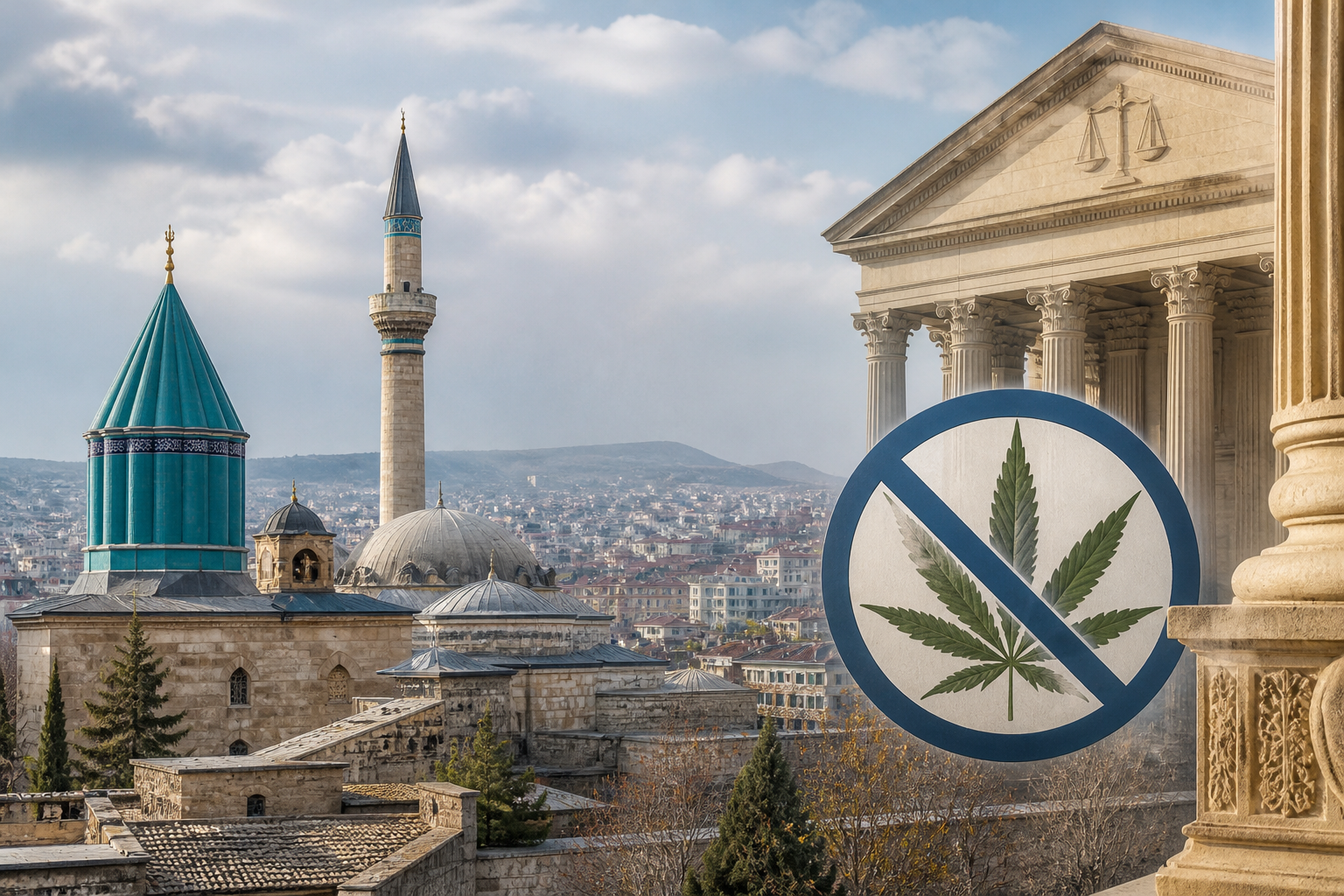
Understanding Cannabis laws in Konya, Turkey is important for residents, students, business visitors, and tourists. Turkey treats recreational cannabis as an illegal controlled substance, and the rules apply in Konya just as they do throughout the country. Local customs, religious and social expectations, or the fact that cannabis may be tolerated differently elsewhere do not create an exception in Konya.
This guide explains the main legal risks surrounding possession, personal use, cultivation, supply, medical products, and travel. It is general information rather than legal advice. Turkish law and enforcement practices can change, so anyone facing an investigation, arrest, or court proceeding should speak with a qualified lawyer in Turkey.
What cannabis laws in Konya, Turkey mean in practice
Konya does not have a separate municipal cannabis code that legalizes marijuana. Controlled-substance offences are primarily governed by national Turkish criminal law. As a result, the basic position on cannabis in Konya is the same as in Ankara, Istanbul, Gaziantep, and other Turkish cities.
Cannabis is commonly described in Turkish as kenevir, while marijuana or cannabis resin may be referred to as esrar. A substance’s name, form, or intended use does not by itself make possession lawful. Flower, resin, extracts, and preparations can all create legal problems, particularly when authorities believe that a product contains controlled cannabinoids.
For the current wording of Turkish legislation, consult the official Turkish legislation database. The relevant legal classification and consequences depend on the facts, the substance, the quantity, and the authorities’ assessment of the conduct.
Is weed in Konya legal for recreational use?
No. Recreational use of cannabis is not legally permitted in Konya. Buying, possessing, carrying, sharing, or consuming cannabis can expose a person to criminal investigation. Using cannabis in a private apartment, hotel room, vehicle, or other supposedly discreet setting does not automatically remove the legal risk.
People sometimes assume that a small amount for personal use is effectively legal because it may be treated differently from commercial trafficking. That is an unsafe assumption. Turkish law distinguishes between personal-use conduct and more serious supply offences, but personal-use cases can still involve police action, prosecution, compulsory procedures, treatment-related measures, supervision, and court proceedings.
There is also no lawful recreational retail system in Konya. A seller offering cannabis through social media, messaging applications, nightlife contacts, or informal networks is not operating a licensed market. Buying from such a source creates both possession and potential fraud or personal-safety risks.
Possession, personal use, and police contact
Possession is one of the most important issues for anyone researching Turkey marijuana regulations. The legal outcome may depend on the amount, packaging, statements made by the person involved, prior history, location, and whether investigators suspect distribution. Quantity alone should not be treated as a guaranteed legal threshold.
Personal use can be investigated under provisions of Turkey’s criminal law concerning the purchase, acceptance, possession, or use of narcotic or stimulant substances. Depending on the case, authorities may consider treatment, supervision, testing, or prosecution. These procedures are not a general legalization scheme and should not be interpreted as permission to possess cannabis.
If police stop or search you
- Remain calm and avoid physical resistance or confrontation.
- Do not sign documents you do not understand. Request a qualified interpreter where necessary.
- Ask to contact a lawyer, especially before making detailed statements.
- Do not guess about the contents or origin of a substance.
- Keep copies of identification and important medication documentation available, but do not assume a prescription from another country automatically protects cannabis possession in Turkey.
Foreign nationals should also request consular assistance if appropriate. Consular staff cannot cancel Turkish proceedings, but they may explain available support and help a person contact family or legal professionals.
Cannabis cultivation and hemp in Konya
Growing cannabis at home is not a safe legal alternative to buying it. Unlicensed cultivation of plants intended for drug production can lead to criminal consequences, even when the plants are grown indoors, in a private garden, or in small numbers. Seeds, seedlings, mature plants, harvested material, and cultivation equipment may all become relevant to an investigation.
Industrial hemp is a separate subject from drug-producing cannabis, but it is not an unrestricted loophole. Hemp cultivation in Turkey is subject to national rules, permissions, approved purposes, and administrative controls. A person should not plant hemp in Konya based only on a seed packet, an online advertisement, or a belief that low-THC varieties are automatically exempt.
Farmers, researchers, and businesses considering hemp should verify the applicable licensing and agricultural requirements with the competent Turkish authorities before importing seed, planting, harvesting, processing, or selling a product. The legality of one approved hemp activity does not authorize recreational cannabis cultivation.
Medical cannabis in Konya
Questions about medical cannabis in Konya require particular care because the term may refer to very different products. Turkey permits certain medicines and cannabinoid-related preparations within a regulated medical framework, but that does not mean that ordinary cannabis flower, home-made extracts, or products purchased abroad can be used freely.
A patient should obtain medical treatment through a licensed Turkish healthcare professional and use only a product that is lawfully prescribed, dispensed, and authorized for use in Turkey. A diagnosis, foreign prescription, medical card, or doctor’s letter may explain a patient’s situation, but it should not be assumed to override Turkish controlled-substance rules.
Before travelling with any cannabis-related medicine, contact the relevant Turkish authorities and the medicine’s manufacturer or prescribing institution. Ask about the exact active ingredients, documentation, quantity limits, packaging, and import requirements. The Turkish Ministry of Health’s official health information portal is a suitable starting point for checking health-related guidance, although it may not answer every individual customs or criminal-law question.
Travelling to Konya with cannabis or CBD products
Visitors should treat international travel with cannabis as especially high risk. Bringing cannabis into Turkey, taking it out of Turkey, or moving it through an airport can create import, export, customs, or narcotics-related problems. Transit through another country may also trigger that country’s laws.
Do not assume that a product labelled CBD, hemp, wellness, herbal, or natural is automatically permitted. Products can contain measurable THC or other controlled ingredients, and labels may be inaccurate. Oils, gummies, capsules, cosmetics, vape cartridges, dried plant material, and concentrates should not be carried into Konya without confirming their status through official channels.
Practical precautions include:
- Do not pack cannabis, cannabis flower, resin, edibles, vapes, or extracts for a flight to Turkey.
- Do not mail or courier cannabis-related products to a hotel, residence, or workplace.
- Do not rely on a foreign dispensary receipt or medical recommendation as proof of Turkish legality.
- Check the status of any prescribed medicine before departure and carry only documentation that matches the actual product.
- Never accept a parcel or suitcase containing unknown plant material or medication for transport across a border.
Buying, sharing, or selling cannabis
Supply-related conduct is more serious than simple personal possession. Selling, supplying, transporting, storing for another person, importing, exporting, or organizing a transaction can lead to severe criminal exposure. Sharing cannabis without payment can still be treated as distribution-related conduct depending on the facts.
Online activity can also become evidence. Messages arranging a sale, payment records, advertisements, delivery instructions, repeated packaging, or communications with multiple buyers may affect how authorities characterize a case. Deleting messages after an incident is not a substitute for legal advice and may create additional complications.
Tourists should be particularly cautious about informal offers from strangers. Apart from legal danger, such encounters can involve scams, robbery, extortion, contaminated substances, or police operations. There is no lawful cannabis café, recreational dispensary, or social club system in Konya that visitors can use as a safe retail option.
Social context and local considerations in Konya
Konya is known for its conservative social environment and religious heritage, but social attitudes do not replace written law. Some residents may strongly disapprove of drug use, while others may avoid discussing it. Public visibility can attract attention even before a formal legal issue arises.
Using cannabis in public places, near schools, around religious sites, at transport hubs, or in a vehicle can create additional practical and legal problems. Smoke, smell, disorder, or interactions with police can turn a private assumption into a public incident. The safest approach for residents and visitors is not to possess or use recreational cannabis at all.
For broader comparisons, readers can also review this guide to marijuana laws in Ankara and the related overview of cannabis rules in Istanbul. The underlying national framework remains more important than city-by-city differences.
What to do if you need legal or medical help
If you are questioned, detained, or accused of a cannabis offence in Konya, contact a Turkish criminal-defense lawyer promptly. A lawyer can explain the allegation, review search and seizure procedures, arrange interpretation, and advise on communication with investigators and prosecutors. Do not rely on online comments or advice from a seller, hotel employee, or fellow traveller.
If the issue concerns treatment, speak with a licensed physician in Turkey. Be open about medicines and supplements, including products purchased abroad. A clinician can help identify lawful treatment options without assuming that a foreign cannabis product can be continued in Turkey.
Conclusion
The short answer to questions about cannabis laws in Konya is that recreational cannabis is illegal and carries real criminal and travel risks. Possession and use can lead to investigation, while cultivation, supply, import, and export may bring much more serious consequences. Medical and industrial hemp issues are regulated categories, not general exceptions for personal cannabis use.
Whether you are searching for weed in Konya, asking about cannabis in Konya, or carrying a medicine, do not assume that private use, a small quantity, a CBD label, or a foreign prescription makes the conduct lawful. Check current official guidance and obtain advice from a qualified Turkish lawyer or healthcare professional before taking action.