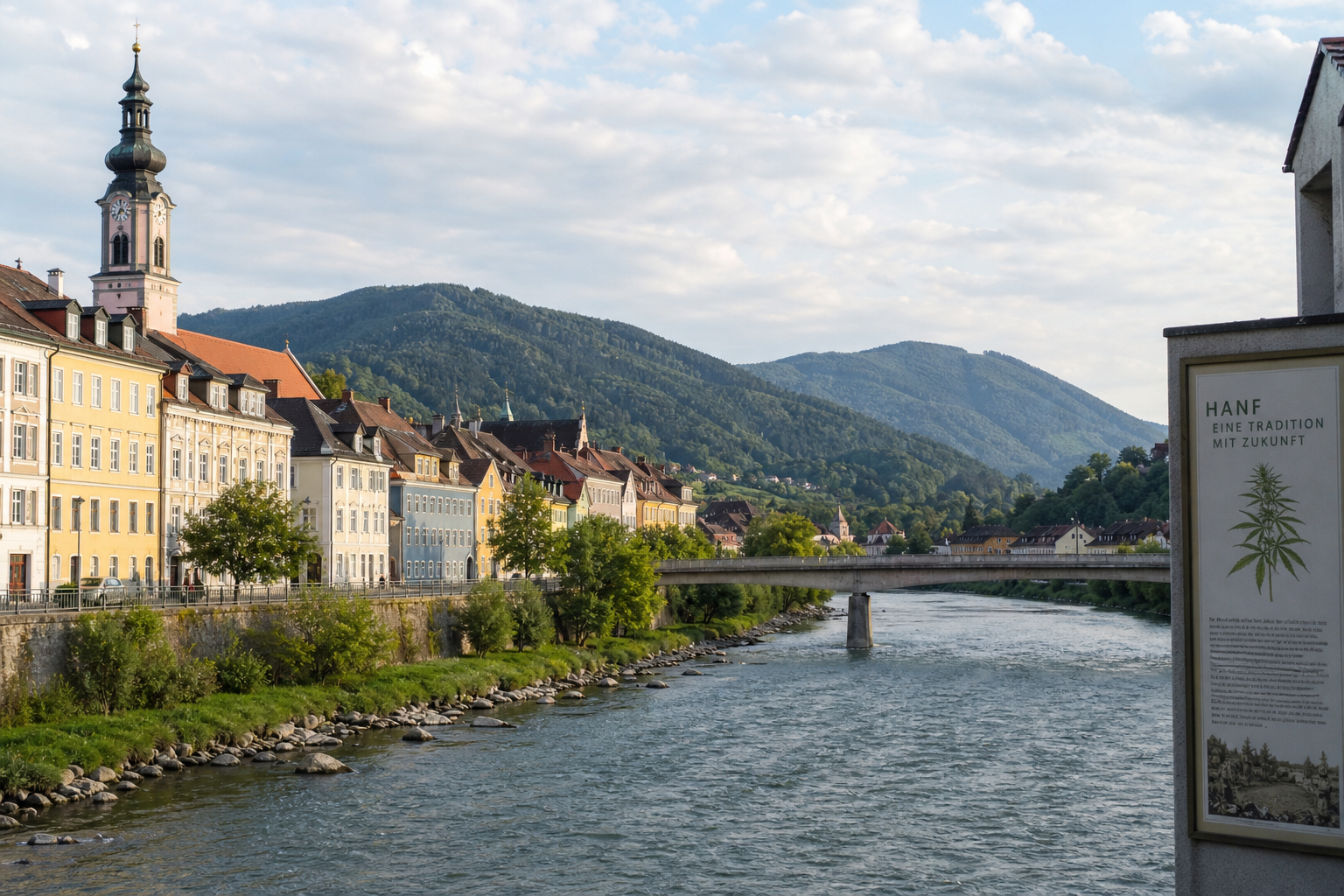
Marijuana culture in Bruck an der Mur is best understood through the town’s wider social setting, Austria’s drug laws and the difference between informal attitudes and legal permission. Bruck an der Mur is a historic town in Styria, positioned near important rail and road connections and surrounded by a landscape where outdoor recreation and close community ties matter. That does not create a special local cannabis regime: the same Austrian rules apply here as elsewhere in the country.
For residents, visitors and anyone researching weed in Bruck an der Mur, the most useful approach is practical rather than sensational. This guide explains what is and is not legal, how CBD differs from intoxicating cannabis, what medical access usually involves, and how people can make safer decisions without treating rumors or online offers as reliable information.
What marijuana culture means in Bruck an der Mur
“Culture” can describe several overlapping things: public attitudes, private social use, music and youth scenes, interest in hemp products, medical conversations and debates about drug policy. These elements should not be confused with a legal retail market. Austria does not have a general adult-use cannabis dispensary system comparable with regulated markets in some other countries.
In a town such as Bruck an der Mur, cannabis-related conversations may take place among different groups with different priorities. Some people focus on criminal justice and prevention, others on medical treatment, and others on low-THC hemp or CBD products. Local culture is therefore not one unified scene. It is a mixture of personal experiences, national media coverage, health information and changing views about regulation.
There is also an important distinction between visibility and prevalence. A product seen in a shop, a discussion on social media or a smell in a public place does not prove that use is widespread or lawful. Responsible reporting should avoid presenting unverified local anecdotes as facts.
Cannabis laws in Bruck an der Mur and Austria
The cannabis laws in Bruck an der Mur are Austrian federal laws, not rules created by the municipality. Cannabis containing intoxicating levels of THC is generally controlled under Austria’s narcotics framework. Possession, acquisition, production and supply can create legal problems, while cultivation for obtaining drug-producing cannabis is also restricted.
Austria’s system can be more nuanced than a simple “legal” or “illegal” label. In some circumstances, authorities and courts may consider personal circumstances, the quantity involved, previous conduct, treatment needs or whether a case can be diverted. Such possibilities do not turn possession into a legal activity. They also should not be interpreted as a guarantee that a person will avoid investigation, prosecution or other consequences.
Sale and distribution carry especially serious risks. Buying from an informal source can expose someone to criminal liability, fraud, unknown potency and contamination. Bringing cannabis across a border is another major concern because customs and import rules apply even when a substance was permitted where it was purchased. Visitors should consult current official information, such as the Austrian government’s official information portal, rather than relying on travel forums or social media posts.
Public use and everyday conduct
Using cannabis in a park, near a station, outside a venue or in shared accommodation can create practical problems even apart from the underlying drug offence. Smoke and odor affect other people, and intoxication can lead to unsafe decisions. Driving or cycling after using cannabis is particularly dangerous and may have serious legal and insurance consequences. A private setting is not automatically a legal setting, but avoiding public exposure and never driving while impaired are important harm-reduction principles.
- Do not assume that decriminalization discussions mean recreational possession is permitted.
- Do not carry cannabis across the Austrian border without specialist legal advice.
- Do not drive, cycle on roads or operate machinery after using an intoxicating substance.
- Keep products away from children, pets and anyone who has not agreed to be around them.
CBD, hemp and the search for weed in Bruck an der Mur
People searching for weed in Bruck an der Mur may actually be looking for several different products. CBD flower, hemp tea, cosmetics, oils and food products are not interchangeable with high-THC cannabis. CBD is not generally associated with the same intoxicating effect as THC, but a product’s legal status depends on its ingredients, intended use, labeling and compliance with Austrian and European rules.
Low-THC does not mean risk-free or automatically approved. Products can be mislabeled, contain more THC than expected or fall under rules affecting food, cosmetics, medicines or novel products. A reputable seller should provide clear product information and avoid medical promises. Claims that a CBD product can cure anxiety, pain, cancer or addiction should be treated with skepticism unless supported by appropriate medical evidence and lawful authorization.
For a nearby comparison of product-focused information, readers can review this guide to CBD shops and buying considerations in Kapfenberg. Kapfenberg is close to Bruck an der Mur, but its retail environment does not change the law in Bruck or make intoxicating cannabis available legally.
Medical cannabis in Bruck an der Mur
Medical cannabis in Bruck an der Mur should be approached as a healthcare question, not as a shortcut to recreational supply. Patients with symptoms they believe might respond to cannabis should speak with a qualified doctor who can review their diagnosis, existing medicines, mental-health history and possible interactions. A clinician may recommend an authorized medicine or another treatment, depending on the situation.
Medical products are different from unregulated flowers or oils advertised online. The prescribing, dispensing and reimbursement arrangements can depend on the particular medicine and the patient’s circumstances. Patients should never replace prescribed treatment with a product of uncertain origin, and they should tell healthcare professionals about cannabis or CBD use so that interactions and side effects can be assessed.
Potential concerns include drowsiness, impaired attention, anxiety, paranoia, psychosis risk in vulnerable people and interactions with alcohol or sedating medicines. Pregnancy, adolescence and a personal or family history of psychotic illness require particular caution. The Austrian public-health portal Gesundheit.gv.at is a useful starting point for general health information, although personal treatment decisions belong with a healthcare professional.
Questions to ask a healthcare professional
- What condition is being treated, and what evidence supports the proposed medicine?
- Could cannabis interact with current prescriptions, alcohol or other substances?
- What dose, formulation and follow-up plan are appropriate?
- Could the treatment affect driving, work, study or childcare?
- What symptoms should prompt urgent medical help?
Local attitudes, privacy and community discussion
Cannabis conversations in Bruck an der Mur are likely to reflect broader Austrian debates: prevention, youth protection, health-led interventions, personal liberty and concerns about illegal supply. People can hold different views without supporting unsafe behavior. A constructive local discussion focuses on evidence and practical outcomes rather than stereotypes about users or exaggerated claims about harmlessness.
Privacy also matters. Sharing photographs, names or allegations about suspected use can harm people and may create legal problems. Community groups, parents and educators should discuss cannabis in age-appropriate language. Young people need clear information about developing brains, impaired concentration, pressure from peers and the risks of mixing substances. Fear-based messages can be less useful than calm explanations of health and legal consequences.
Anyone worried about their own use should seek confidential advice from a doctor, addiction counseling service or public-health provider. Warning signs can include using more often than intended, neglecting work or relationships, needing cannabis to sleep or relax, spending beyond one’s means, or continuing despite anxiety and other harms.
Safer choices for residents and visitors
There is no completely risk-free way to use an intoxicating drug. The safest option is not to use it, particularly for minors, pregnant people, people with relevant mental-health vulnerabilities and anyone who must drive or remain responsible for others. For adults who are making personal decisions, basic harm reduction can still reduce avoidable danger.
- Check the law before buying, carrying or traveling with any cannabis-related product.
- Avoid unknown-strength products and never assume that a familiar-looking item is accurately labeled.
- Do not mix cannabis with alcohol, sedatives or other drugs.
- Use only in a private, safe environment and avoid driving or cycling afterward.
- Store products securely and clearly separated from ordinary food, especially in homes with children.
- Seek medical help for chest pain, severe confusion, loss of consciousness, extreme agitation or suspected poisoning.
Visitors should also remember that Bruck an der Mur is a connected regional town, not a place where tourist-focused cannabis sales are automatically legal. Transport hubs, hotels, festivals and nightlife do not create exceptions. Anyone seeking lawful information about another part of Styria may also find the overview of CBD products and safety considerations in Leoben useful, while keeping in mind that product rules can change.
How to find reliable information
Online cannabis information often combines accurate guidance with outdated legal claims, sales language or exaggerated health promises. A reliable source should identify the country, distinguish THC from CBD, explain uncertainty and avoid guaranteeing legal outcomes. Official government and public-health websites are preferable for rules, medicines, emergencies and treatment pathways.
Local pharmacies, doctors and counseling services can help with health questions, but they cannot make an unapproved product legal. When in doubt, record the exact product name and ingredients, ask a professional and avoid using it until its status and risks are clear. This is especially important for imported oils, edible products and anything marketed as a powerful or “medical” solution.
Conclusion
Marijuana culture in Bruck an der Mur is shaped less by a distinctive local cannabis market than by Austria-wide law, regional community life and growing public interest in health and hemp products. Cannabis containing THC remains legally risky, while CBD and medical products must be assessed according to their specific ingredients and authorized use.
The most responsible approach is informed and local: follow Austrian law, avoid informal supply, treat medical questions through healthcare professionals, protect young people and never drive while impaired. Understanding the difference between social discussion, CBD retail and lawful medical treatment makes it easier to navigate cannabis-related questions in Bruck an der Mur without relying on rumor or unsafe assumptions.