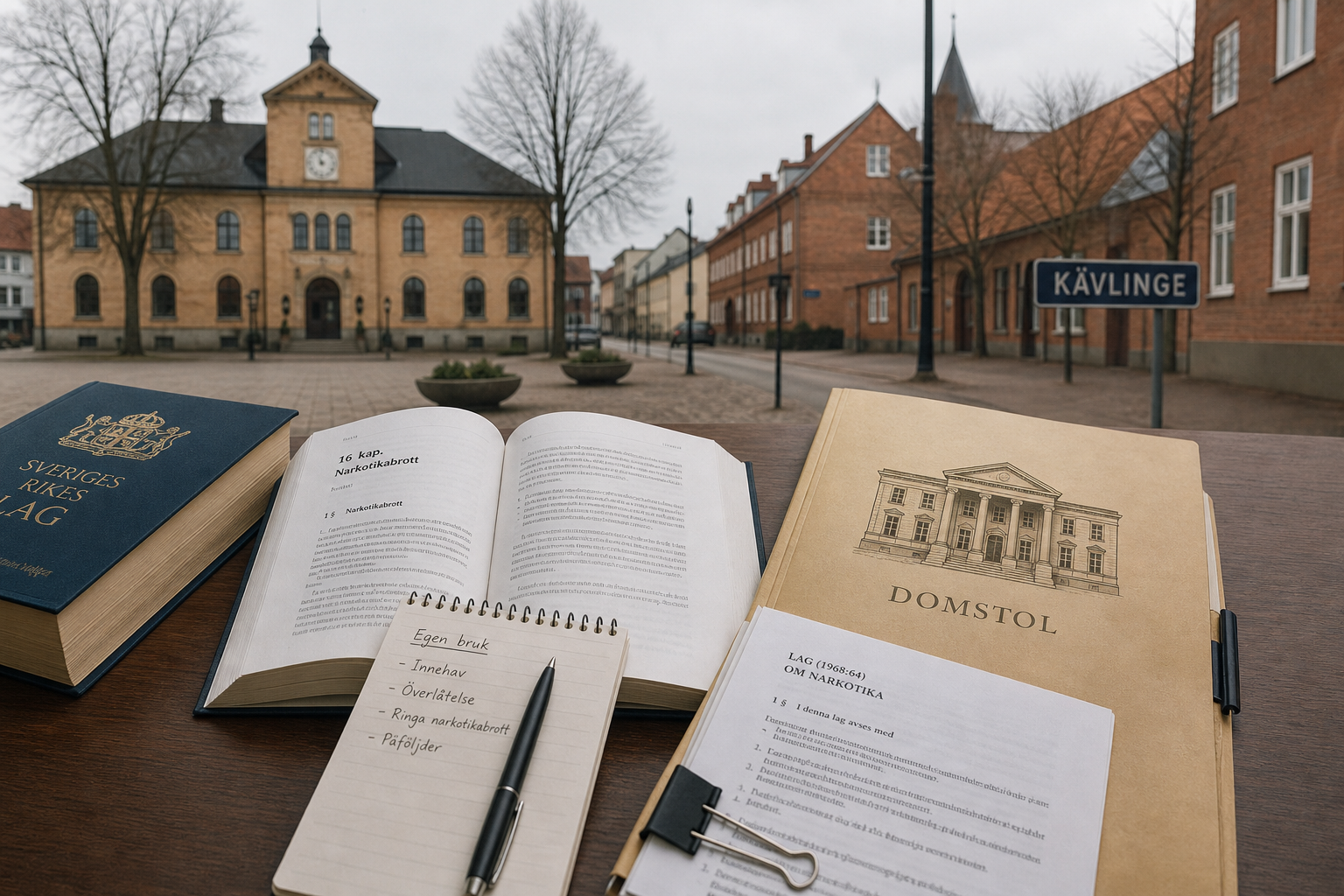
People searching for Cannabis possession limits in Kävlinge often want to know whether Swedish law allows a small amount for personal use. The short answer is no. Kävlinge does not have a local cannabis allowance or a municipality-specific possession threshold. Swedish national narcotics law applies in Kävlinge, just as it does elsewhere in the country.
Possessing cannabis without lawful authorization can lead to criminal proceedings even when the quantity is small and the substance is intended only for personal use. The legal outcome depends on the evidence, the substance, the amount, the person’s conduct and other circumstances. This guide explains the basic rules without treating any quantity as a safe or permitted limit.
Is there a legal cannabis possession limit in Kävlinge?
There is no legal amount of recreational cannabis that a person may possess in Kävlinge. Swedish law generally treats cannabis as a narcotic drug, and unauthorized possession is prohibited. The same rule applies to dried cannabis, resin or hashish, cannabis preparations and other controlled forms of the substance.
This means that “a small amount” is not the same as “a legal amount.” A small quantity may affect how authorities assess the seriousness of an alleged offence, but it does not create a personal-use exemption. Quantity can be relevant to sentencing and classification, yet it is only one part of the legal assessment.
For the statutory framework, consult the official Swedish Narcotic Drugs Punishments Act. Laws and court practice can change, so anyone facing an investigation should obtain current legal advice rather than relying on an online summary.
Cannabis laws in Kävlinge are national, not municipal
Kävlinge Municipality cannot create a separate recreational cannabis limit. Local authorities may be involved in prevention, social support, public-health work and cooperation with police, but the criminal rules come from Swedish national legislation.
As a result, the practical answer for cannabis in Kävlinge is the same as in nearby municipalities such as Lund, Lomma or Svedala: unauthorized possession is potentially criminal, and the circumstances determine how a case is handled. A visitor, resident or commuter should not assume that local customs, private property or a low quantity changes the national rule.
Private possession is still possession
Keeping cannabis in a home, vehicle, bag, locker or other private place may still meet the legal concept of possession. The fact that cannabis is not used in public does not make it lawful. Similarly, ownership and physical control are not always identical legal concepts; authorities may examine who knew about the substance and who had control over it.
Sharing or transferring cannabis can create additional legal concerns. Passing cannabis to another person, arranging a transaction or storing it for someone else may be treated more seriously than simple personal possession, depending on the facts.
How Swedish authorities assess a possession case
There is no published Kävlinge table that converts a particular number of grams into an automatic result. Investigators, prosecutors and courts look at the whole situation. Relevant factors may include the type and amount of drug, packaging, messages, money, scales, statements, previous conduct and indications of distribution.
Authorities may also need to establish that the substance is a controlled drug. Testing, seizure procedures and evidence about possession can become important. A person’s explanation is considered alongside the other evidence, but there is no general right to avoid consequences simply by describing the cannabis as personal use.
- Substance: Cannabis products can differ in form and concentration, while legal classification remains important.
- Quantity: Amount may influence seriousness, but there is no guaranteed lawful minimum.
- Purpose: Evidence suggesting personal use differs from evidence suggesting supply or distribution.
- Context: Packaging, communications, cash and other surrounding facts may affect the assessment.
- Prior history: Previous offences and the individual circumstances of the accused may be relevant to the outcome.
For current information about police procedures and narcotics-related rules, the official Swedish Police information on narcotics is a more reliable starting point than social-media posts or informal claims about “allowed” amounts.
What penalties can possession involve?
Swedish narcotics offences can range from less serious to serious offences. A minor possession case may result in a fine, while more serious circumstances can lead to imprisonment. The potential penalty is not determined by a simple Kävlinge-specific weight limit.
Courts consider the statutory offence, the quantity and nature of the drug, the role of the accused and the overall circumstances. Possession connected with supplying others, repeated offending or a larger quantity can raise the seriousness significantly. It is therefore misleading to publish a single penalty prediction based only on grams.
A criminal case can also have practical consequences beyond the immediate sentence. Depending on the person’s circumstances, a conviction may affect employment screening, professional licensing, immigration matters or travel. The effect is not identical for every person, and an individual legal assessment is necessary.
Police contact and suspected possession
If police suspect narcotics possession, they may investigate, question people and seize suspected substances in accordance with applicable legal rules. A person should remain calm, avoid physically resisting, and ask what is happening. Anyone questioned as a suspect should consider requesting a lawyer before making detailed statements.
Do not destroy, hide or transfer suspected drugs. Such actions can create further complications. If a search, seizure, arrest or formal interview has occurred, prompt advice from a Swedish criminal-defense lawyer is more useful than trying to predict the result from online quantity charts.
Medical cannabis and prescribed medicines
Recreational cannabis possession and prescribed treatment are different legal questions. Some cannabis-based medicines may be available through the Swedish healthcare system under medical supervision, but that does not make ordinary cannabis lawful for personal medical use.
A patient should use only the medicine that was prescribed or lawfully supplied, follow the prescription and retain appropriate pharmacy or prescription documentation. Bringing medicine into Sweden, carrying it across borders or travelling with controlled medication may involve additional requirements. A product bought from an unregulated source should not be assumed to be equivalent to a prescribed medicine.
Information about medicinal marijuana access in Höör provides related regional context, but it does not replace advice from a Swedish doctor, pharmacy or lawyer. Medical need by itself is not a general defence to unauthorized possession.
Weed in Kävlinge: common misunderstandings
“There is a personal-use threshold.”
Swedish law may distinguish less serious cases from more serious ones, but that distinction is about criminal classification and sentencing. It is not permission to possess a specified personal amount.
“A private home is outside the rules.”
Private location does not remove the narcotics prohibition. Possession at home can still be investigated if authorities have lawful grounds to do so.
“CBD products are always legal.”
CBD products must be assessed carefully. Product composition, THC content, labeling, intended use and applicable product rules matter. A product marketed as CBD should not automatically be treated as risk-free or lawful. Anyone considering a CBD product should verify its status through reliable Swedish authorities and the product’s documentation.
“Tourists are treated differently.”
Visitors are generally subject to the same criminal law while in Sweden. Non-residents may also face additional practical issues involving travel, immigration or contact with authorities. Carrying cannabis across a border can raise separate customs and narcotics concerns.
Practical steps for residents and visitors
The safest legal approach is not to possess, buy, transport or share unauthorized cannabis in Kävlinge. If you encounter cannabis or are unsure whether a medicine or product is lawful, avoid moving it or giving it to another person while seeking reliable advice.
- Check whether a medicine was lawfully prescribed and supplied.
- Keep prescription and pharmacy documentation when carrying prescribed controlled medication.
- Do not rely on claims that a certain number of grams is automatically permitted.
- Do not carry cannabis across municipal or national borders.
- If contacted as a suspect, ask about your procedural rights and seek a qualified lawyer.
Health concerns should also be taken seriously. Cannabis can affect attention, reaction time, memory and judgment, and combining it with alcohol or other drugs can increase risk. Driving after using cannabis is especially dangerous and may create separate legal consequences. If someone experiences severe anxiety, confusion, chest pain, loss of consciousness or other urgent symptoms, contact emergency healthcare services.
How this compares with other Swedish possession guidance
Readers researching cannabis possession regulations in Finspång will find the same central principle: Swedish national law applies, rather than a local municipal allowance. Regional articles can help explain practical questions, but they should not be read as creating different legal limits from one town to another.
The same caution applies to online discussions about cannabis possession rules in Kävlinge. Informal anecdotes may omit important facts, such as whether the substance was prescribed, whether another person was involved or whether police found evidence suggesting supply. A reliable answer must be based on the current law and the particular circumstances.
Conclusion
There is no legal recreational cannabis possession limit in Kävlinge. Unauthorized possession can be a narcotics offence even when the amount is small, and the outcome depends on the substance, quantity, evidence and surrounding circumstances. Kävlinge follows Swedish national law, so residents and visitors should not expect a local exemption.
Prescribed cannabis-based medicines are a separate matter and must be used within the applicable medical and prescription rules. For any real police investigation, seizure or court matter, consult a Swedish lawyer promptly. For health concerns, use a doctor, pharmacy or emergency healthcare service rather than relying on unverified claims about cannabis in Kävlinge.