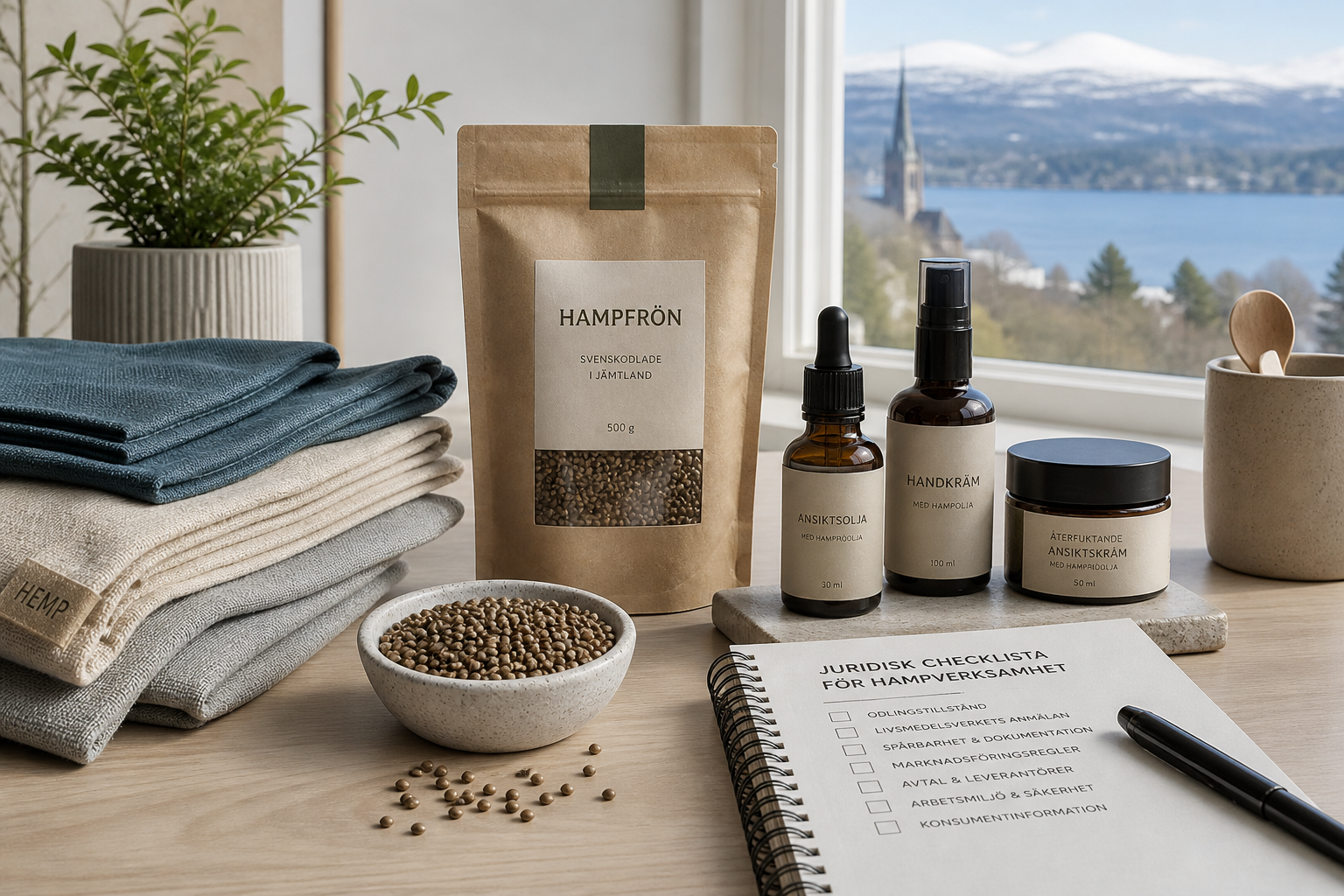
People searching for hemp products in Östersund may be looking for food, clothing, skincare, building materials, CBD products or other goods made from the hemp plant. These categories are not treated identically under Swedish law. A hemp seed food, a fibre jacket and a CBD oil can have very different legal and safety considerations, even when they are sold under the same broad “hemp” label.
This guide explains the practical differences. It focuses on how to shop responsibly in Östersund, what to check on packaging, why CBD deserves extra caution and how to avoid confusing non-intoxicating hemp products with controlled cannabis. Rules can change, so consumers should verify the current position with Swedish authorities before buying, importing or using a product.
What counts as a hemp product?
Hemp usually refers to varieties of Cannabis sativa cultivated for fibre, seed, food or other industrial purposes. The word does not automatically describe a psychoactive product. A hemp item may contain no cannabinoids at all, or it may contain naturally occurring compounds such as cannabidiol, commonly called CBD.
Common categories include:
- Hemp seed foods: shelled seeds, flour, protein products and cold-pressed seed oil. Hemp seeds are mainly used as food ingredients and are not the same as cannabis resin or marijuana.
- Fibre and textiles: clothing, bags, rope, paper and other durable goods made from hemp stalk fibres.
- Cosmetics: creams, soaps and balms that may contain hemp seed oil. Cosmetic products should be assessed by their ingredients and claims, not simply by the word “hemp”.
- CBD products: oils, capsules, gummies, vape liquids and topical products marketed around cannabidiol. Their legal status may depend on formulation, intended use, marketing and the presence of controlled substances.
- Garden and agricultural products: seeds or materials connected with cultivation. These require particular care because permitted industrial hemp cultivation is subject to specific conditions.
Hemp in Östersund and the Swedish legal framework
Östersund does not have a separate local cannabis law that replaces national Swedish rules. The key questions are what the product contains, how it is presented and whether it falls under food, cosmetics, medicine, tobacco-related or controlled-substance rules.
Industrial hemp should not be confused with unrestricted cannabis. Cultivation of approved industrial hemp varieties may be possible under agricultural rules, but that does not mean every cannabis plant or seed product is lawful. Possession, sale, import and production of products containing controlled levels or forms of THC can create serious legal problems.
The safest approach is to treat every product category separately. A hemp-seed snack bought from a normal food retailer is not legally equivalent to a bottle of CBD oil ordered from another country. When in doubt, consult the Swedish Medical Products Agency for medicine and product-related information, and check whether the seller provides a clear explanation of the product’s regulatory category.
Why THC content matters
THC is the cannabinoid most associated with intoxication. Even when a seller describes a product as “hemp-derived”, the presence, concentration and form of THC still matter. Product descriptions such as “full spectrum”, “broad spectrum” or “THC-free” should not be accepted without supporting information.
Laboratory results can be useful, but a certificate is only meaningful when it identifies the tested product, includes a recent test date and comes from a genuinely independent laboratory. A vague statement on a product page is not the same as transparent testing. Consumers should also remember that a test result from one batch does not automatically prove the contents of another batch.
CBD in Östersund: a category requiring extra care
Interest in CBD in Östersund has grown alongside wider interest in wellness products, but CBD is not a universal solution and should not be treated as an ordinary supplement without checking the applicable rules. Products taken by mouth may raise food and medicine questions, while products making therapeutic claims may be regulated differently from simple cosmetics.
The Swedish food regulator provides information about food safety and novel foods through the Swedish Food Agency. Its material is useful when assessing edible products, but consumers should still check the exact product and intended use. A product being available online does not prove that it is approved, correctly labelled or lawful to sell in Sweden.
Be cautious with health claims
Claims that CBD or hemp products can treat anxiety, chronic pain, insomnia, inflammation or another medical condition should be approached carefully. A commercial description is not a clinical diagnosis or proof of effectiveness. If you are considering a cannabinoid product for a health problem, speak with a licensed healthcare professional rather than replacing prescribed treatment based on advertising.
CBD may also be relevant to medication safety. People taking regular medicines, those with liver conditions, pregnant or breastfeeding people and anyone preparing for surgery should ask a clinician or pharmacist before using CBD. The right advice depends on the individual, the dose, the route of administration and the other medicines involved.
How to assess hemp products locally in Östersund
Local shopping can make it easier to ask questions, inspect packaging and return to the seller if there is a problem. Whether buying from a specialist shop, health retailer, pharmacy or food store, use the same basic checks.
- Identify the product category. Is it food, a cosmetic, a textile, a supplement, a medicine or a vape product? Do not rely only on the word “hemp”.
- Read the complete ingredient list. Look for hemp seed oil, hemp extract, CBD, THC and other active ingredients. A front label may omit important details.
- Check the intended use. A cream for external use is not automatically suitable for ingestion. A product sold as a food should not be marketed with unsupported medical promises.
- Look for responsible business information. The seller should provide a business name, contact details, batch information and clear instructions in a language the customer can understand.
- Ask about independent testing. For cannabinoid products, request a batch-specific certificate of analysis showing cannabinoid results and the laboratory’s identity.
- Check storage and packaging. Damaged seals, missing expiry dates, unclear dosage instructions or unusually bold claims are reasons to walk away.
- Keep purchase records. Save the receipt, product page and batch number, particularly for products taken orally or ordered from outside Sweden.
Buying hemp food, cosmetics and textiles
For many shoppers, the lowest-risk way to explore hemp is through non-intoxicating products such as textiles, paper goods or hemp seed foods from established retailers. Hemp seed products can add variety to cooking, but consumers should follow the package instructions and consider allergies, dietary requirements and portion guidance.
Hemp seed oil is different from CBD oil. It is generally used as a food or cosmetic ingredient and is produced from the seeds, while CBD products are usually made from other parts of the plant or from a cannabinoid extract. Similar packaging can create confusion, so read the ingredient list instead of assuming that every “hemp oil” has the same contents.
Cosmetics also deserve a realistic assessment. A hemp cream may moisturise the skin because of its oils and other ingredients, but the presence of hemp does not by itself prove a special therapeutic effect. Avoid products that promise to cure skin disease or make medical claims without appropriate authorisation.
Ordering hemp products online or across the border
Online shopping expands choice but also increases uncertainty. A website may be based outside Sweden, use translated marketing and describe its products according to another country’s rules. Swedish requirements can still matter when an item is shipped to Östersund.
Before ordering, check the seller’s country, delivery terms, ingredient information, return policy and responsibility for customs or regulatory issues. Be especially cautious with CBD flowers, resins, vapes and extracts. These products may resemble controlled cannabis products, and a seller’s statement that an item is legal in its country does not guarantee that it can legally be imported into Sweden.
Travellers should not assume that a product purchased abroad can be carried home without consequences. This is particularly important for oils, edibles, cartridges and products labelled as containing THC or cannabis extract. If the legal status is unclear, leaving the product behind is safer than relying on informal advice from a retailer.
Hemp, CBD and cannabis are not interchangeable
Searches for cannabis laws in Östersund may lead people to information about recreational cannabis, medical cannabis or industrial hemp. These subjects overlap linguistically but not legally. Sweden generally takes a restrictive approach to unauthorised cannabis possession, use, sale and import. A product marketed as hemp is not a shortcut around those rules.
For broader context, readers can compare this topic with our guide to hemp in Uppsala or the practical overview of CBD products in Karlstad. The local setting may differ, but the same basic principle applies: classify the product first, then verify the national rules that govern it.
Practical safety checklist
- Do not drive, cycle in traffic or operate machinery after using a product that could cause impairment.
- Keep cannabinoid products away from children and pets.
- Do not combine CBD or other cannabinoid products with alcohol or medicines without professional advice.
- Start with caution only when the product is lawful, clearly labelled and appropriate for its intended use.
- Stop using a product and seek medical advice if you experience severe dizziness, confusion, allergic symptoms or other concerning effects.
- Report misleading marketing or suspected unsafe products to the relevant Swedish authority or consumer protection channel.
What should shoppers in Östersund remember?
The most useful question is not simply whether a product is “hemp”. Ask what part of the plant it comes from, what it contains, what it is intended to do and which rules apply to that category. This approach works for a bag of hemp seed, a moisturising cream, a CBD edible or an imported extract.
When researching CBD laws in Östersund, rely on current Swedish authority information rather than social media claims or a seller’s legal guarantee. Local stores can provide product details, but they cannot change national controlled-substance, medicine or food rules. If a product has unclear ingredients, exaggerated health promises or no traceable seller, choosing a simpler and better-documented alternative is sensible.
Conclusion
Hemp products in Östersund cover a broad range of legal and practical categories. Hemp textiles, food ingredients and cosmetics should be assessed according to their normal product rules, while CBD oils, extracts, edibles and vapes require much closer attention to formulation, labelling, health claims and THC content.
Buy from transparent sellers, preserve product information, avoid unsupported medical promises and check official Swedish guidance before importing or using a cannabinoid product. A careful distinction between industrial hemp, CBD and controlled cannabis is the foundation for safer and more informed choices in Östersund.