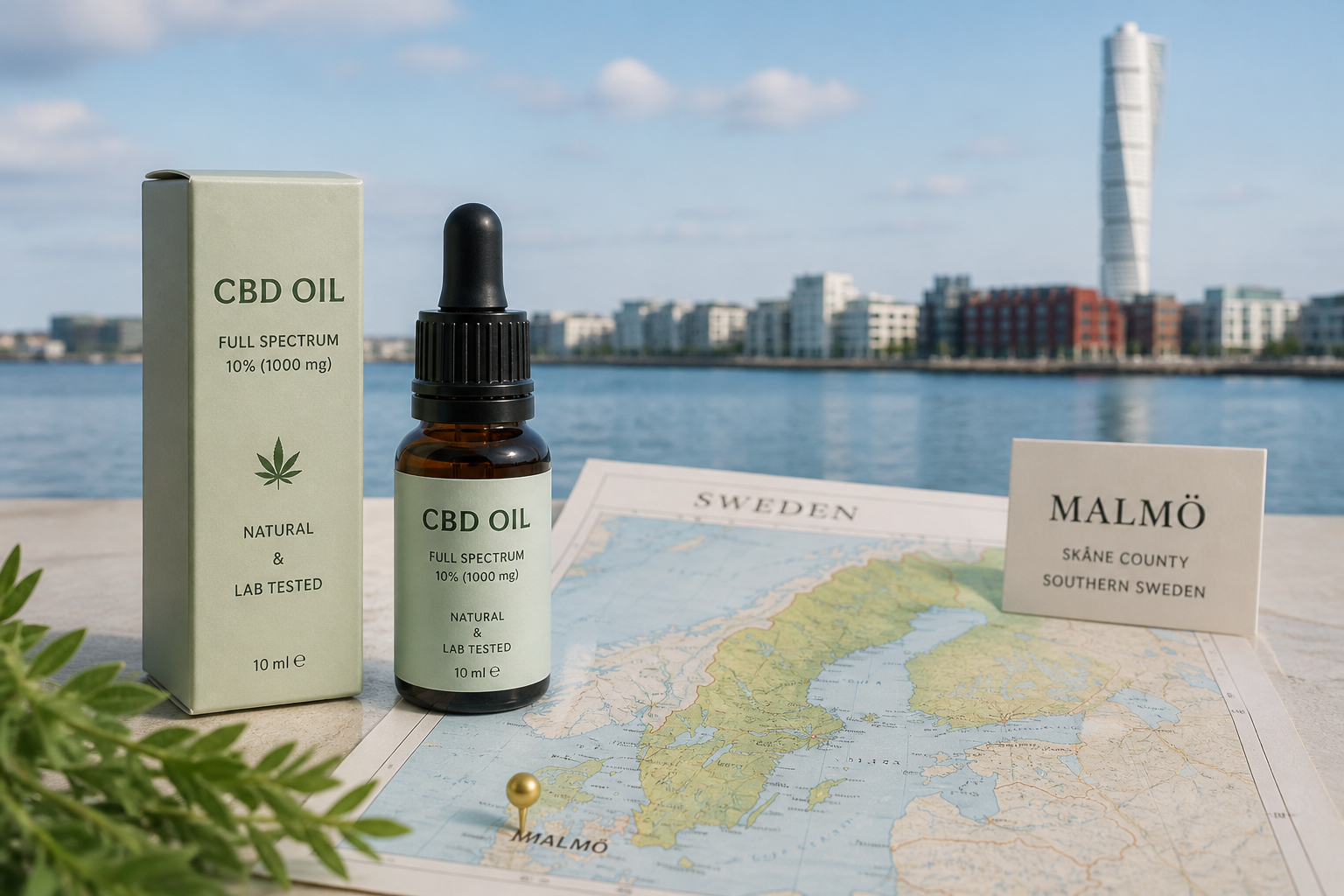
Understanding CBD in Malmö requires more than checking whether a bottle is labelled “hemp” or “THC-free.” Sweden has strict rules around cannabis, medicines, food products and advertising, and the legal position can depend on the product’s ingredients, intended use and claims. A product sold online or in another European country is not automatically lawful to sell, possess or bring into Sweden.
This guide explains how cannabidiol differs from cannabis containing intoxicating THC, what to check before buying, why medical claims matter and how visitors should approach travel. It is general information, not legal or medical advice. Rules and regulatory interpretations can change, so confirm the current position with the relevant Swedish authority before relying on a product.
CBD in Malmö: what the term actually means
CBD, or cannabidiol, is one of the compounds found in the cannabis plant. Unlike THC, CBD is not generally associated with the same intoxicating “high.” That difference does not make every CBD product automatically legal in Sweden. Finished products may also contain trace THC, other cannabinoids, prescription ingredients or substances subject to separate rules.
“CBD” can describe several very different products:
- Oils, capsules and other products intended for oral use
- Cosmetics such as creams, balms and serums
- Vape liquids and inhaled products
- Hemp foods, drinks or supplements
- Prescription or pharmacy products containing cannabidiol
These categories should not be treated as interchangeable. A topical cosmetic, an ingestible supplement and a medicine can face different requirements even when their packaging uses similar language.
CBD laws in Malmö and Sweden
Malmö does not have a separate CBD market law. Swedish national rules apply in Malmö, just as they do in Stockholm, Gothenburg and other municipalities. The key questions are usually whether the product contains THC, whether it is classified as a medicine, whether it is approved as food or a supplement, and what the seller claims it will do.
Swedish authorities have taken a strict approach to cannabis-related products. Products containing THC can create criminal-law risks, while a product marketed to treat or prevent disease may be regulated as a medicinal product rather than an ordinary consumer item. The label alone is not decisive. A product advertised as helping with anxiety, pain, epilepsy, insomnia or inflammation may attract medicinal-product scrutiny even if the package calls it a wellness oil.
For current regulatory information, consult the Swedish Medical Products Agency. It is the appropriate starting point for questions about medicines, medicinal claims and products that may fall within pharmaceutical regulation.
Why THC content matters
THC is the main intoxicating cannabinoid in cannabis. Even when a product is described as broad-spectrum or full-spectrum CBD, it may contain some THC unless laboratory testing demonstrates otherwise. In Sweden, trace amounts should not be assumed to be harmless from a legal perspective.
Certificates of analysis can help, but they are not a complete legal guarantee. Check that the report applies to the exact batch, identifies THC separately, comes from a credible laboratory and includes a recent testing date. Be especially cautious with products that provide no batch number, no ingredient list or only a marketing statement such as “legal everywhere.”
Buying CBD in Malmö
Local availability can change quickly. A shop, website or marketplace listing does not prove that a product complies with Swedish rules. Before purchasing CBD in Malmö, assess the product and the seller rather than relying on the appearance of the packaging.
What to check on the label
- The full ingredient list, including cannabinoids and added substances
- The stated CBD amount per serving and per container
- Whether THC is listed and how it was tested
- A batch or lot number that matches any laboratory report
- The manufacturer or responsible importer and a traceable contact address
- Warnings, age restrictions and storage instructions
- Whether the product makes medical or disease-treatment claims
Be wary of unusually strong promises, missing Swedish information, unexplained “proprietary blends” and products sold only through social-media messages. A responsible seller should be able to explain what the product contains, where it was produced and what category it is intended to fit.
Oils, edibles, vapes and cosmetics are not the same
Oral CBD oils and capsules deserve particular caution because products intended for ingestion can raise food, medicine and novel-food questions. Do not assume that a bottle sold as a supplement in another country can legally be marketed in Sweden. CBD vapes also raise separate concerns about inhalation safety, nicotine rules, electrical devices and product compliance.
Cosmetic products are used on the outside of the body, but “cosmetic” does not mean risk-free or automatically lawful. A cream that simply moisturises is treated differently from one advertised as treating arthritis or eczema. Avoid applying products to damaged skin unless a qualified healthcare professional has advised you to do so.
Medical CBD in Malmö: prescriptions and healthcare
People searching for medical CBD in Malmö may be responding to pain, sleep problems, anxiety, epilepsy or another health concern. CBD should not replace an assessment by a doctor or pharmacist. Evidence varies by condition, and a product purchased online may have a different concentration and purity from a regulated medicine.
Tell a healthcare professional about all CBD products you use, including oils, gummies, vapes and topical products. This is important because cannabidiol may interact with medicines and because the product may contain more or less CBD than its label suggests. It can also cause unwanted effects such as sleepiness, diarrhoea, appetite changes or changes in liver-related laboratory results.
Do not stop prescribed treatment suddenly in order to try CBD. If you are considering it for a serious or persistent symptom, ask a doctor or pharmacist about established treatment options, possible interactions and whether a regulated medicine is relevant. A healthcare professional can also help distinguish a symptom that may need prompt medical attention from a minor complaint suitable for self-care.
Safety advice for CBD users
CBD is not intoxicating in the same way as THC, but it can still affect alertness and may interact with other substances. Start by reading the product instructions and avoid combining it casually with alcohol, sedatives or medicines that cause drowsiness.
- Use only the amount stated on a reliable product label unless a healthcare professional advises otherwise.
- Do not drive, cycle in traffic or operate machinery until you know how the product affects you.
- Keep CBD away from children and pets.
- Pregnant or breastfeeding people should seek medical advice before using it.
- People with liver disease or those taking several medicines should ask a clinician or pharmacist first.
- Stop using the product and seek medical advice if you develop a serious or unusual reaction.
Drug testing is another practical concern. Some CBD products contain detectable THC, and contamination or inaccurate labelling can occur. If your employment, sport or legal situation involves testing, a “THC-free” marketing claim may not provide enough reassurance.
Travelling to Malmö with CBD
Visitors arriving by train from Copenhagen, by ferry, by air or across another border should be cautious with CBD. Bringing a product into Sweden can involve customs, medicinal-product and narcotics rules. A product legally purchased in Denmark, Germany or another country is not automatically acceptable for import into Sweden.
Keep the original packaging and proof of purchase if you are carrying a regulated medicine, but do not treat documentation as permission for every product. Do not decant CBD oil into an unlabelled bottle, and do not carry a product whose THC content you cannot verify. When in doubt, check with Swedish Customs before travelling. The Swedish Customs official website provides the appropriate starting point for border and import questions.
For broader context on Swedish cannabis rules, compare this guide with our practical overview of cannabis in Stockholm and our discussion of marijuana in Gothenburg. The city names differ, but the main national legal framework remains relevant.
CBD, cannabis and “weed in Malmö”: keeping the terms clear
People sometimes use the phrase weed in Malmö when they are actually looking for CBD. The terms should not be confused. “Weed” commonly refers to cannabis containing THC and intended for intoxication, while CBD products are marketed for cannabidiol content. Possession, sale and use of cannabis containing THC remain serious legal matters in Sweden.
Likewise, searching for cannabis in Malmö may produce information about recreational cannabis, medical products, hemp and CBD all at once. Read the details carefully. A product’s plant origin does not determine its legal status by itself, and a hemp label does not remove the need to check THC, intended use and regulatory classification.
A practical checklist before you buy
- Identify the product category: cosmetic, food, vape, supplement or medicine.
- Read the complete ingredient list and check for THC or other cannabinoids.
- Ask for a batch-specific certificate of analysis from a credible laboratory.
- Look for a traceable seller and avoid exaggerated health claims.
- Check Swedish rules before ordering from another country.
- Ask a pharmacist or doctor about interactions if you take medication or have a health condition.
- Keep the packaging and product documentation until you have finished using it.
Conclusion
CBD in Malmö is best approached as a regulated product question, not simply a shopping decision. Swedish national rules can depend on THC content, product type, marketing claims and whether the item is being imported. Consumers should verify the product’s ingredients, avoid unsupported medical promises and seek professional advice when health conditions or medicines are involved.
For visitors, the safest approach is to check Swedish rules before crossing the border and not assume that a product legal elsewhere is legal to carry into Sweden. Careful labelling, reliable sourcing and current information from Swedish authorities can reduce avoidable legal and health risks.