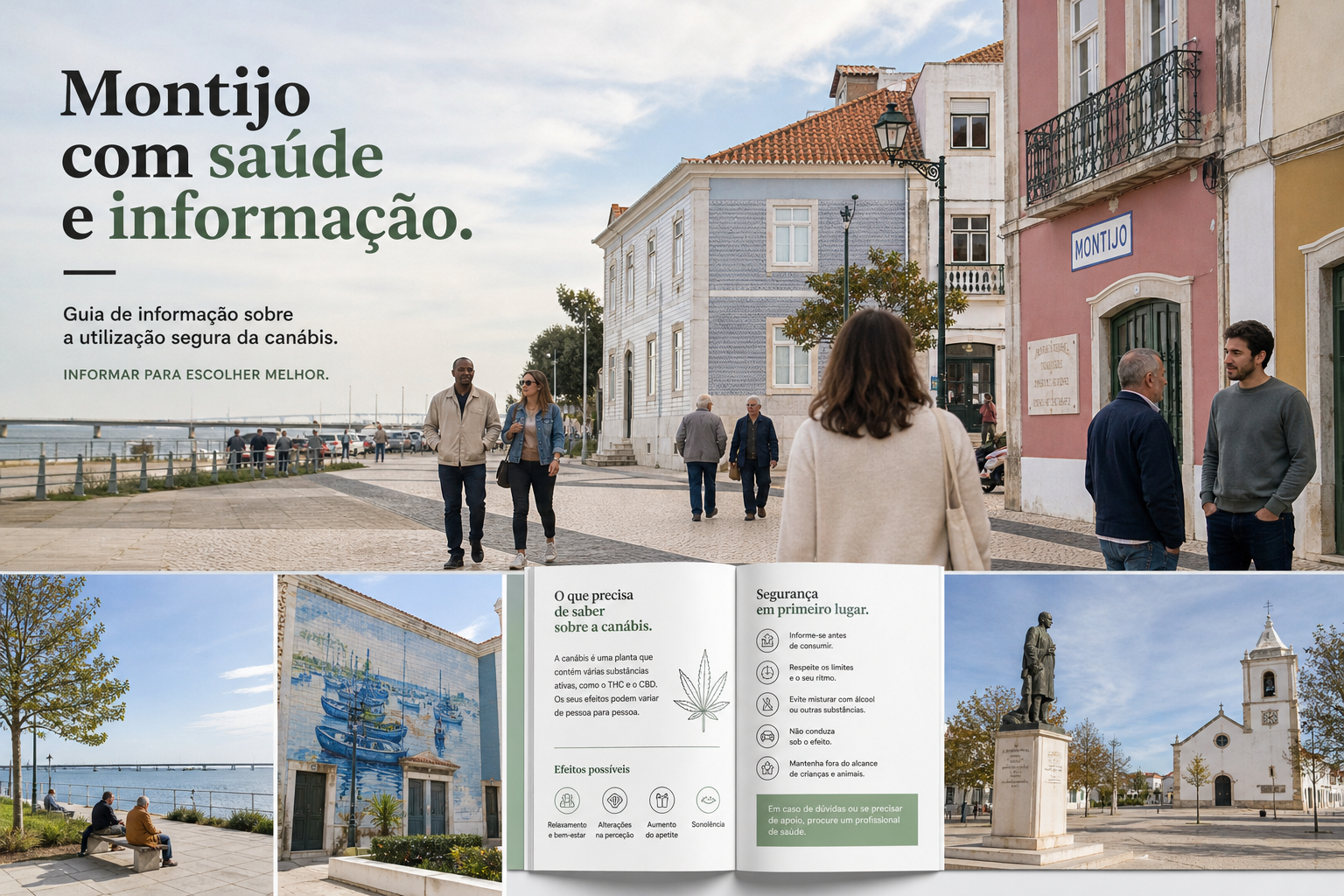
Cannabis education in Montijo should begin with clear information rather than assumptions. Residents, visitors and families may have questions about Portuguese law, medical access, possible health effects, product labels, driving and where to find trustworthy advice. Montijo is close to Lisbon and Setúbal, but the national legal framework applies throughout Portugal; local geography does not create a separate cannabis market or a different set of possession rules.
This guide explains the essentials in plain language. It is educational, not legal or medical advice, and it does not promote illegal purchasing, cultivation or consumption. For an overview of cannabis-related topics in the wider area, readers may also find this guide to cannabis in Lisbon useful. When a question involves a specific legal case, prescription or health condition, consult a qualified professional or the relevant Portuguese authority.
Why cannabis education matters in Montijo
Good information helps people separate law from social perception and regulated medicine from unverified products. A person asking about weed in Montijo may actually be asking one of several different questions: Is possession legal? Can cannabis be prescribed? Is CBD the same as high-THC cannabis? What happens if someone drives after using it? Each question requires a different answer.
Education is also important because product strength, route of administration and individual health circumstances can change the risk. Edibles may take longer to produce noticeable effects than inhaled products, while concentrates can contain much higher levels of cannabinoids than traditional plant material. Packaging may be incomplete or misleading when a product comes from an unverified source.
- Legal literacy: understanding the difference between decriminalisation, legalisation and regulated supply.
- Health literacy: recognising potential effects, interactions and warning signs.
- Consumer awareness: checking whether a product is authorised, labelled and appropriate for its stated use.
- Community safety: preventing impaired driving, accidental ingestion and exposure among children.
Cannabis laws in Montijo and Portugal
Portugal is widely known for its policy of decriminalising the personal use and possession of limited quantities of drugs, but decriminalisation is not the same as unrestricted legality. Personal-use cases can still involve an administrative process, assessment or other official measures. Selling, supplying, importing, exporting and trafficking remain serious offences, and the legal consequences depend on the facts of the case.
Home cultivation should not be treated as automatically permitted. People often confuse public discussion of drug policy with a general right to grow cannabis. Anyone considering cultivation, possession or transport should obtain current legal advice instead of relying on informal claims online.
The most reliable starting point for medicine and product regulation is the official INFARMED website, Portugal’s medicines and health-products authority. It provides information relevant to authorised medicines, pharmacies and regulatory responsibilities. For broader drug-policy and prevention information, the official SICAD information portal is another useful source.
Decriminalisation is not a retail system
A common misunderstanding is that Portugal’s approach created legal recreational cannabis shops similar to those found in some other countries. That conclusion is unsafe. Decriminalisation may change how certain personal-use situations are handled, but it does not establish a general permission to buy cannabis from unlicensed sellers, advertise it or sell it in public.
There is also no reason to assume that a product advertised in Montijo, Lisbon or a nearby municipality is legal simply because the seller uses professional language or displays a laboratory-looking label. Consumers should be cautious about claims involving guaranteed potency, medical cures or anonymous delivery.
Medical cannabis in Montijo
Medical cannabis in Montijo is part of Portugal’s national healthcare and medicines framework. Access depends on the patient’s condition, clinical judgement, an authorised prescription and the availability of an approved product through the appropriate pharmacy channel. It is not a general substitute for a medical consultation, and a person should not use another patient’s medicine.
A doctor may consider cannabis-based treatment when clinically appropriate, taking account of symptoms, previous treatments, possible benefits and risks. Patients should ask how the medicine should be taken, how long it may take to work, whether it can interact with other medicines and what side effects require medical attention. Follow-up matters because the treatment may need adjustment or may not be suitable.
Unregulated oils, flowers, vapes or edible products marketed as “medical” are not necessarily authorised medicines. The word medical on a website or package does not prove that a product has been assessed for quality, composition or therapeutic effectiveness. Keep prescribed products in their original packaging and follow the instructions supplied by the prescriber and pharmacist.
Health and safety information
Cannabis can affect attention, memory, coordination, reaction time and perception. Some people may experience anxiety, panic, dizziness, nausea or confusion. Effects can vary according to THC concentration, dose, previous experience, age, sleep, other substances and underlying mental or physical health conditions.
Frequent or heavy use may create problems with concentration, motivation or daily functioning for some people, and some users develop dependence. Adolescents and people with a personal or family history of psychosis or certain psychiatric conditions may face particular concerns. Pregnancy and breastfeeding also require professional medical advice rather than assumptions based on informal harm-reduction claims.
Lower-risk principles
No method makes non-prescribed cannabis risk-free, but several principles can reduce avoidable harm. Do not combine cannabis with alcohol, sedatives or other intoxicants. Avoid driving, cycling in traffic, operating machinery or doing safety-sensitive work after use. Be especially cautious with delayed-effect products, since taking more before the first dose has fully taken effect can lead to unexpectedly intense effects.
- Do not use an unknown product with uncertain contents or strength.
- Keep cannabis and medicines away from children and pets, preferably in a locked location.
- Do not share prescribed medicine or represent it as suitable for someone else.
- Seek help if severe confusion, chest pain, breathing difficulty, loss of consciousness or a serious mental-health crisis occurs.
- Speak with a doctor or pharmacist if cannabis use is affecting sleep, work, relationships or the ability to stop.
CBD, THC and product-label awareness
THC and CBD are different cannabinoids. THC is primarily associated with intoxication, although its effects are not identical for every person. CBD is not generally intoxicating in the same way, but a CBD label does not automatically guarantee that a product is risk-free, legal for every intended use or free from THC and contaminants.
People researching cannabis in Montijo should examine the product category, intended use, ingredients, warnings, batch information and manufacturer details. They should also be wary of products claiming to treat cancer, anxiety, pain or other conditions without reliable clinical support. A supplement, cosmetic or hemp item is not automatically a medicine.
Hemp-based products can create additional confusion because “hemp” may refer to a plant variety, fibre, seed product or cannabinoid product. The legal treatment can depend on composition, presentation and intended use. When the label is unclear, the safest choice is to ask a pharmacist or avoid the product rather than guess.
Driving, public spaces and everyday responsibilities
Drug-impaired driving is a serious safety issue. A person may feel able to drive while their attention and reaction time are still affected. The responsible approach is not to drive after consuming cannabis and to arrange a sober alternative. Legal questions about testing, evidence and penalties should be directed to a qualified Portuguese lawyer because outcomes depend on the circumstances.
Public consumption can create nuisance, exposure and safety concerns even when people believe they are acting privately or discreetly. Smoke and vapour can affect other people, while edible products can be mistaken for ordinary food. Avoid use around children, schools, workplaces, public transport and anyone who has not consented to exposure.
Visitors comparing local rules may also consult this practical guide to cannabis tourism in Setúbal, while remembering that a guide is not a replacement for current official advice. Nearby municipalities do not override Portuguese national law.
How to evaluate cannabis information online
Reliable cannabis education should identify the source, date and limits of its claims. Be cautious when an article promises guaranteed effects, presents anonymous testimonials as evidence or uses dramatic language to sell a product. A trustworthy source distinguishes established information from uncertainty and avoids telling every reader that the same product or dose will work in the same way.
- Check whether the information comes from a government authority, health professional, recognised medical institution or transparent research organisation.
- Look for the date and confirm that the legal information is still current.
- Separate medical evidence from personal stories and marketing language.
- Compare claims with official Portuguese guidance before acting on them.
- Ask a pharmacist, doctor or lawyer when the issue involves treatment, an offence or a personal medical condition.
For readers comparing legal guidance across the region, the existing overview of cannabis regulations in Barreiro may provide useful context. The key principle remains the same: local education should clarify national rules, not imply that a nearby municipality has created a separate legal regime.
Where to seek help in Montijo
A pharmacist can help with questions about an authorised medicine, interactions and safe storage. A doctor can discuss symptoms, mental health, dependence and whether a cannabis-based treatment is clinically appropriate. People worried about their own use can ask a healthcare professional for confidential support rather than waiting for the situation to worsen.
For urgent symptoms, contact emergency services. For non-urgent legal questions, use a qualified Portuguese lawyer or an official public body. Avoid relying on sellers, social-media groups or anonymous forums for advice about criminal exposure, prescriptions or serious health conditions.
Conclusion
Cannabis education in Montijo is most useful when it combines accurate law, realistic health information and practical responsibility. Portugal’s decriminalisation policy does not mean that recreational cannabis is freely legal, and medical cannabis is not the same as an unverified product marketed online. Understanding THC and CBD, avoiding impaired driving, protecting children and checking official sources can help residents and visitors make safer decisions.
The best approach is to treat cannabis questions as specific questions: legal, medical, consumer or safety-related. Use official Portuguese information, speak with qualified professionals when necessary and do not mistake confident advertising for reliable guidance.