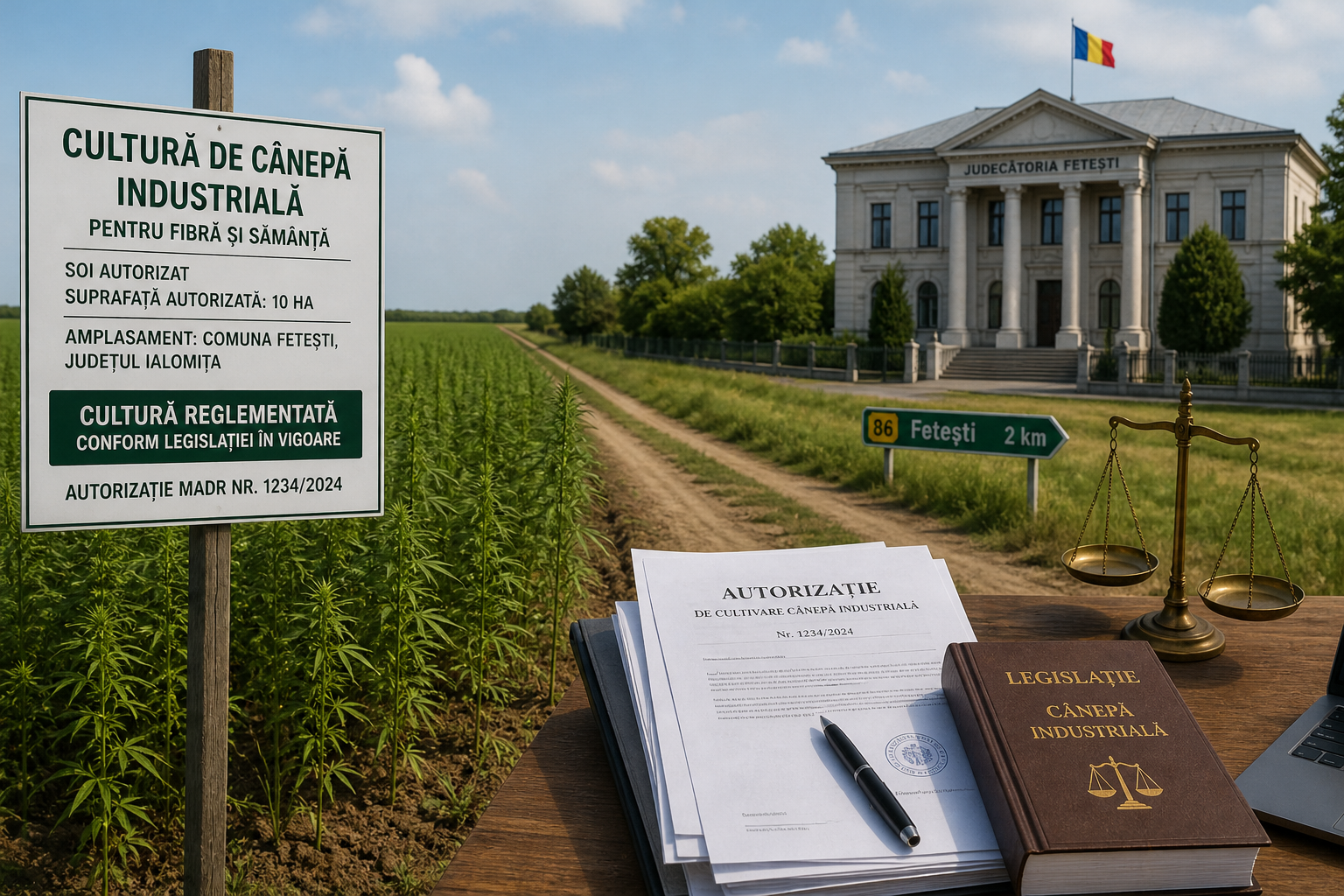
Understanding the cannabis cultivation laws in Fetești starts with an important distinction: Fetești does not have a separate city-level cannabis code. The main rules come from Romanian national law, and they apply in homes, gardens, agricultural land and rented properties throughout Ialomița County. Local authorities may affect planning, nuisance, land use or public-order issues, but they cannot legalize conduct prohibited by national criminal law.
This guide explains what the rules generally mean for residents, landowners, visitors and farmers. It separates prohibited cannabis growing from the more narrowly regulated cultivation of industrial hemp, and it addresses common misunderstandings about personal use, medical products, CBD and private property. It is general legal information, not a substitute for advice from a Romanian lawyer or a current decision from the competent authorities.
How Romanian law applies in Fetești
Romania regulates controlled drugs primarily through national legislation rather than municipal ordinances. The central framework includes Law No. 143/2000 on preventing and combating illicit drug trafficking and consumption, together with legislation concerning medicines, controlled substances and authorized hemp cultivation.
The official Romanian legislation portal should be checked for the current wording of laws and amendments. This matters because criminal provisions, administrative procedures and regulated medical uses can change, and online summaries may omit important details.
For someone searching for cannabis in Fetești, the practical message is straightforward: the fact that cultivation takes place behind a fence, in a greenhouse or on privately owned land does not by itself make it lawful. Ownership of the property is not a defense to an otherwise prohibited activity.
Cannabis cultivation laws in Fetești: what is generally prohibited
Growing cannabis plants without the required legal authorization can expose a person to criminal investigation. Romanian law treats cultivation as a controlled activity, and the legal risk does not depend only on whether the plants are mature, harvested or intended for sale. The authorities may assess the plants, the quantity, the alleged purpose, cultivation equipment, communications, financial evidence and other circumstances.
A private growing operation can therefore create several possible legal issues:
- Planting or maintaining cannabis plants without authorization.
- Possessing harvested cannabis or other cannabis material.
- Producing, preparing, storing or distributing controlled substances.
- Supplying seeds or plants where the transaction is connected with illicit cultivation.
- Using a property for drug production or allowing another person to do so.
These categories should not be treated as a checklist that determines a sentence. The applicable offense and consequences depend on the facts, the substance involved, the alleged purpose, prior conduct and the evidence collected. A person contacted by police should avoid guessing about the law and should seek a qualified Romanian criminal-defense lawyer promptly.
Does personal use make cultivation legal?
No. A belief that a small number of plants are only for personal use does not automatically create a right to grow cannabis. Personal-use allegations may be treated differently from trafficking allegations, but that distinction does not turn unauthorized cultivation into a lawful activity.
This is one of the most important points in any discussion of cannabis cultivation rules in Fetești. “Private,” “small-scale” and “for myself” describe circumstances; they are not general cultivation licenses. The legal consequences may be different from those associated with organized supply, but a person should not assume that a personal garden is risk-free.
Industrial hemp is different, but not unregulated
Industrial hemp is often confused with marijuana because both are cannabis plants. The legal treatment can differ when a crop belongs to an authorized, compliant industrial-hemp category and is grown under the applicable agricultural rules. That difference does not mean that any cannabis seed can be planted and later described as hemp.
Farmers and landowners considering hemp should verify the requirements before sowing. Depending on the activity and current rules, relevant issues may include:
- Use of an approved or legally acceptable variety and compliant seed.
- Documentation showing the source and characteristics of the seed.
- Registration, notification, authorization or supervision by the competent agricultural authorities.
- Rules concerning THC content, sampling, testing and crop inspections.
- Restrictions on the sale, storage, processing and transport of the harvested material.
- Separate obligations for subsidies, traceability, land use and environmental compliance.
Because agricultural requirements can change and may depend on the crop and intended use, a prospective grower should contact the relevant local agricultural authority and obtain written guidance before planting. A commercial hemp plan should be documented in advance rather than defended after a police inspection.
Why seeds and CBD products can cause confusion
Seeds, flowers, oils, cosmetics and food products are not interchangeable in law. A product marketed online as CBD or hemp may contain a controlled substance, may be mislabeled or may be subject to separate rules for medicines, food, cosmetics or novel foods. Buying a product from a website does not prove that it is lawful to grow, possess or import.
The same caution applies to seeds. The availability of seeds from a shop or online marketplace does not necessarily authorize germination. Before ordering or importing any cannabis-related product, check its exact composition, intended use, documentation and Romanian import requirements.
Medical cannabis and prescribed products
Romania’s rules for cannabis-related medical products should not be confused with a general right to cultivate cannabis at home. Even where a doctor prescribes a lawful medicine, the prescription does not ordinarily authorize the patient to grow plants, produce extracts or replace the prescribed product with home-made material.
Patients should use only products supplied through lawful medical or pharmaceutical channels and should ask a doctor or pharmacist about the exact product, dosage, interactions and driving risks. The National Agency for Medicines and Medical Devices of Romania is an appropriate starting point for official information about medicines and regulatory responsibilities.
People researching medical cannabis in Fetești should also distinguish between a medicine approved or lawfully supplied in Romania and a general wellness product sold with broad claims. A product described as “natural,” “full spectrum” or “legal everywhere” may still require careful verification.
What happens if authorities discover plants?
An inspection, search or seizure can lead to a formal investigation. The immediate steps and eventual outcome depend on the facts, but the process may involve plant identification, laboratory analysis, photographs, witness interviews, device searches and review of messages or purchase records. The number of plants alone may not answer every legal question.
If police or prosecutors become involved, practical steps include:
- Remain calm and do not obstruct lawful proceedings.
- Ask what legal status you have in the procedure and whether you are being questioned as a witness, suspect or defendant.
- Request a lawyer before making detailed statements if your answers could expose you to criminal liability.
- Do not delete messages, move plants or destroy equipment, since such actions can create additional problems.
- Keep copies of relevant agricultural, medical or purchase documents and provide them to your lawyer.
This information is not a suggestion to conceal evidence or avoid lawful investigation. It is a reminder that legal representation is especially important when the classification of plants, products or conduct is disputed.
Local issues for homes, apartments and rural land
National drug law is only part of the practical risk. A growing operation may also lead to complaints involving smell, light, noise, humidity, electrical modifications, fire safety or unauthorized building work. In an apartment, landlords, condominium associations and neighbors may have separate civil or contractual concerns. In rural areas around Fetești, agricultural land-use rules and access arrangements can also matter.
These local issues do not make cultivation lawful or unlawful by themselves, but they can bring attention to an activity and create additional disputes. Renters should never assume that a landlord’s informal permission overrides criminal or agricultural regulation. Likewise, a greenhouse or storage building does not change the legal status of the crop.
Readers comparing local information may find it useful to review the related guide on marijuana possession laws in nearby Slobozia, while remembering that the governing national rules—not the city name—usually determine the core drug-law analysis.
Travel, transport and online purchases
Visitors searching for weed in Fetești should not assume that a local contact, accommodation provider or online seller is offering a lawful product. Possessing, carrying or transporting cannabis can create legal exposure even when the person did not grow it. Taking cannabis across a county boundary, onto a train or into a hotel can add practical risks without changing the underlying rules.
Importing seeds, flowers, oils or medicines can be particularly complicated. Border authorities may apply customs, controlled-substance and pharmaceutical rules, and a product lawful in another country may not be lawful to bring into Romania. Travelers should carry only medicines that are properly documented and should obtain specific advice before crossing a border with any controlled or cannabis-derived product.
For regional travel planning, the guide to cannabis travel restrictions in Medgidia offers a useful comparison, but it should not be treated as a replacement for current official advice.
Common myths about cannabis cultivation in Fetești
“A few plants are automatically legal.”
There is no general rule that makes a small home crop lawful simply because it is small. Personal-use arguments may affect how conduct is assessed, but they do not provide an automatic exemption from cultivation restrictions.
“A balcony or greenhouse is private, so police cannot act.”
Private property does not create immunity from criminal law. Search and seizure powers are governed by legal procedures, and the location of the plants does not itself decide whether cultivation is authorized.
“CBD means every cannabis plant is legal.”
CBD products and industrial hemp are subject to their own requirements. The label on a product or the intended use of a plant cannot replace proof of compliance with Romanian rules.
“A foreign prescription permits home cultivation.”
A prescription from another country does not automatically authorize cultivation or possession in Romania. Medical travelers should verify recognition, packaging, documentation and import rules before travel.
How to reduce legal risk
The safest approach for residents and farmers is to verify the legal basis before planting or purchasing anything cannabis-related. Ask a Romanian lawyer or the competent public authority for advice that matches the intended activity. For industrial hemp, retain seed certificates, contracts, field records and correspondence with authorities. For medical products, use regulated channels and preserve prescriptions and pharmacy documentation.
Do not rely on social-media claims, foreign legalization news or a seller’s statement that a product is “legal.” Laws can distinguish between the plant, its flowers, extracted cannabinoids, finished medicines, food products and industrial materials. Those distinctions are technical and may depend on testing, labeling and authorization.
Conclusion
The main lesson from the cannabis laws in Fetești is that cultivation is governed chiefly by Romanian national law. Unauthorized cannabis growing for personal use, sale or any other purpose can create criminal risk, even on private land and even when the crop is small. Industrial hemp may be possible only within the applicable agricultural and regulatory framework, while medical access does not generally authorize home cultivation.
Before planting, importing, selling or using a cannabis-related product, verify its legal category and obtain current Romanian advice. If authorities are already involved, speak with a qualified lawyer and preserve relevant documents. Careful verification is safer than relying on assumptions about privacy, CBD, personal use or the difference between Fetești and another Romanian city.