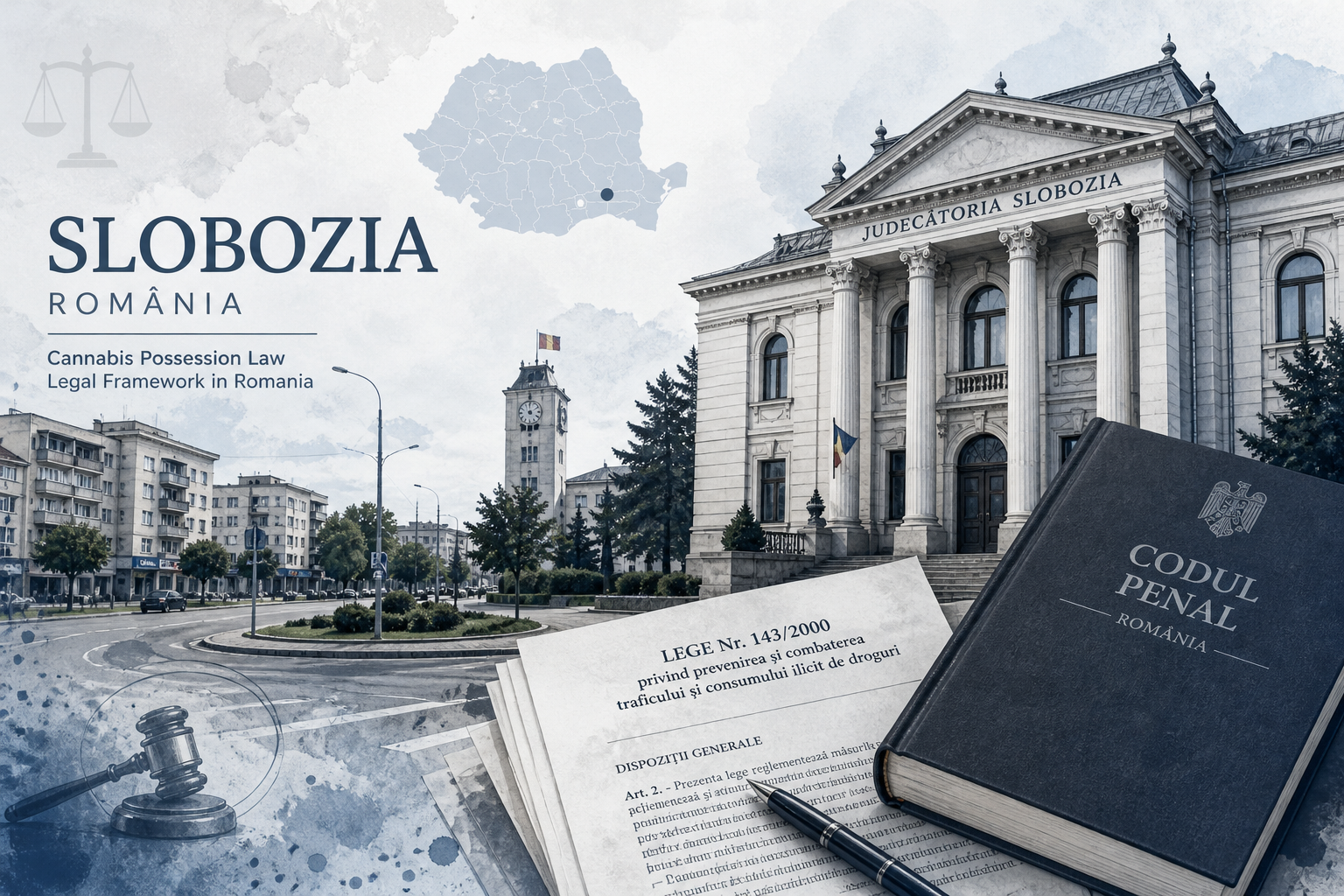
Understanding marijuana possession laws in Slobozia requires looking primarily at Romanian national law rather than a separate city ordinance. Slobozia, the capital of Ialomița County, follows the same criminal and administrative framework that applies throughout Romania. Possessing cannabis without legal authorization can create serious consequences even when the amount appears small or is intended only for personal use.
This guide explains the general legal position, how personal possession differs from supply-related conduct, why police and prosecutors may assess the circumstances carefully, and what residents and visitors should do if they are questioned. It is general information, not individualized legal advice. Romanian legislation can change, and a lawyer should review the details of any real case.
How cannabis possession is treated in Slobozia
There is no special Slobozia rule that makes recreational marijuana possession lawful. The central framework is Romania’s national legislation on drugs, including Law No. 143/2000 on preventing and combating illicit drug trafficking and consumption. Cannabis is generally treated within the category of risk drugs, while the legal classification of a particular substance should be confirmed from the applicable legislation and expert analysis.
Under the Romanian framework, acquiring, holding or using a controlled drug without authorization may constitute a criminal offense. The fact that cannabis was found in a private home, vehicle, bag or other personal space does not automatically make possession legal. Likewise, an argument that the substance was for personal use does not remove the possibility of criminal proceedings; it may instead affect which provision authorities consider applicable.
For the official text of Romanian legislation, consult the Romanian legislation portal. Because legal wording and penalties may be amended, readers should check the current version or obtain advice from a qualified Romanian criminal lawyer.
Personal use, possession and supply are not the same
A key issue in cannabis possession in Slobozia cases is the difference between conduct connected to personal consumption and conduct suggesting distribution. Authorities may examine the quantity, packaging, messages, money, scales, cultivation equipment, statements and other evidence. No single factor should be treated as a guaranteed rule for predicting the outcome.
Possession for personal consumption
Romanian law contains a separate provision for acquiring or possessing drugs for personal consumption without authorization. For a risk drug, the statutory range has traditionally been lower than for high-risk drugs and may include imprisonment or a fine, depending on the applicable legal text and the facts. A lower potential range does not mean that possession is merely a civil violation or that an individual will simply receive a warning.
Personal-use cases can still involve seizure of the substance, laboratory testing, questioning, a criminal investigation and possible referral to prosecutors or courts. The final result may depend on evidence, prior history, procedural issues, the person’s conduct and the decisions of the competent authorities.
Possession connected to supply
When evidence suggests sale, delivery, distribution, transport for another person or an intention to supply others, the case can be treated much more seriously than simple personal possession. The relevant penalties may be substantially higher, especially if the substance is legally classified as high-risk or if other aggravating circumstances apply.
Sharing cannabis without payment should not automatically be assumed to be harmless. Giving a controlled substance to another person may raise legal issues even where there is no commercial profit. Anyone facing allegations involving another person should obtain legal advice before making detailed statements.
What “weed in Slobozia” means legally
Searches for weed in Slobozia often reflect an interest in availability, not necessarily an understanding of the law. In Romania, informal language such as weed, marijuana, hash or cannabis does not determine legal status. The substance, its chemical composition, its form and the applicable schedules and legislation matter.
Police or prosecutors may send suspected material for forensic analysis. Visual appearance, a seller’s description or a product label is not a reliable legal test. A product marketed as cannabis may contain controlled cannabinoids or other substances, while a product sold as hemp or CBD may raise separate compliance questions.
It is also risky to assume that a small quantity, an unfinished joint or residue cannot lead to action. The practical consequences of a case depend on the evidence and the legal classification, not only on how a person describes the material.
CBD, hemp and medical cannabis concerns
People searching for cannabis in Slobozia may encounter hemp flowers, CBD oils, cosmetics, food products or products advertised as legal alternatives. “Hemp” and “CBD” are not universal guarantees that a product can be possessed or carried without risk. Product composition, THC content, intended use, labeling and the rules applying to food, medicines or controlled substances can all be relevant.
Travelers should be particularly cautious with oils, vape cartridges, flowers, edibles and prescription products. A product lawfully purchased in another country may still create problems when brought into Romania. Packaging, a receipt or a foreign prescription may not by itself authorize importation or possession under Romanian law.
Medical treatment is also not the same as recreational legalization. Some medicines may be permitted under controlled conditions, but authorization depends on the specific medicine, prescription, supply chain and applicable rules. A person using a cannabinoid-based medicine should keep the original packaging and medical documentation and should confirm travel requirements before crossing a border.
Cannabis laws in Slobozia and police encounters
The phrase cannabis laws in Slobozia covers more than the final penalty for possession. Police may investigate suspected possession, use, purchase, transport or supply. During an encounter, a person should remain calm, avoid obstructing officers and avoid volunteering inaccurate explanations.
- Ask, politely, whether you are being treated as a witness, suspect or detained person.
- Request a lawyer before giving a detailed statement about the source, ownership or intended use of the substance.
- Do not sign documents that you do not understand. Ask for an interpreter if language is a problem.
- Do not destroy, hide or transfer suspected substances or related evidence.
- Keep records of what was seized and request copies of relevant procedural documents where legally available.
These steps do not guarantee a particular outcome, but they can help protect procedural rights. A person should not assume that being cooperative means answering every substantive question without legal assistance.
Possible consequences of marijuana possession
The consequences of marijuana possession in Slobozia can vary. They may include seizure and testing of the material, police questioning, a criminal investigation, prosecutorial decisions, court proceedings and a criminal record if there is a conviction. The precise result depends on the charge, evidence, classification of the drug and the person’s history.
Authorities may also investigate related conduct. For example, driving after using cannabis can create separate and serious legal risks. A driver’s belief that they feel normal does not establish that driving is lawful or safe. Cannabis can affect reaction time, attention and judgment, and combining it with alcohol or other substances increases danger.
In addition to legal exposure, use may carry health risks. The European Union Drugs Agency provides evidence-based information about cannabis, drug harms and European drug policy through its official drug information resources. People experiencing anxiety, panic, dependence, sleep problems or other difficulties should speak with a healthcare professional rather than relying on informal advice.
Practical guidance for residents and visitors
For visitors, the safest approach is not to carry cannabis into Slobozia or anywhere else in Romania unless a specific, documented legal authorization clearly applies. Airports, border crossings, trains, hotels and private accommodation do not create exceptions to national drug law. Do not accept a package, bag or vehicle compartment for someone else if you do not know what it contains.
Residents should be skeptical of claims that cannabis is “decriminalized,” that police ignore small amounts or that a product is safe because it was sold online. Online listings, social-media messages and informal sellers are not authoritative sources of legal permission. Buying through an unregulated channel can expose a person to both criminal risk and unknown product strength or contamination.
If a legal issue has already arisen, write down the timeline while memories are fresh, preserve messages and documents, avoid posting about the incident publicly, and contact a Romanian lawyer experienced in criminal or drug-related cases. Do not alter evidence or ask others to coordinate stories.
Related Romanian cannabis law topics
Local context can help readers compare how national rules apply in different Romanian cities, but the legal framework remains national. For a broader comparison, see this guide to cannabis possession laws in Turda and the overview of marijuana penalties in Voluntari. These comparisons should not be read as evidence that one city permits conduct prohibited in another.
Conclusion
Marijuana possession in Slobozia is governed mainly by Romanian national drug law, not by a special city-level recreational cannabis regime. Possessing cannabis without authorization may be a criminal matter even when the amount is small or intended for personal use. Supply-related conduct, driving after use, cross-border transport and uncertain CBD or hemp products can create additional risks.
The most reliable approach is to avoid carrying or purchasing unauthorized cannabis, treat product labels with caution, and seek prompt advice from a qualified lawyer if police or prosecutors become involved. Because statutes and enforcement practices can change, current official legislation and professional legal advice should take priority over rumors or online claims.