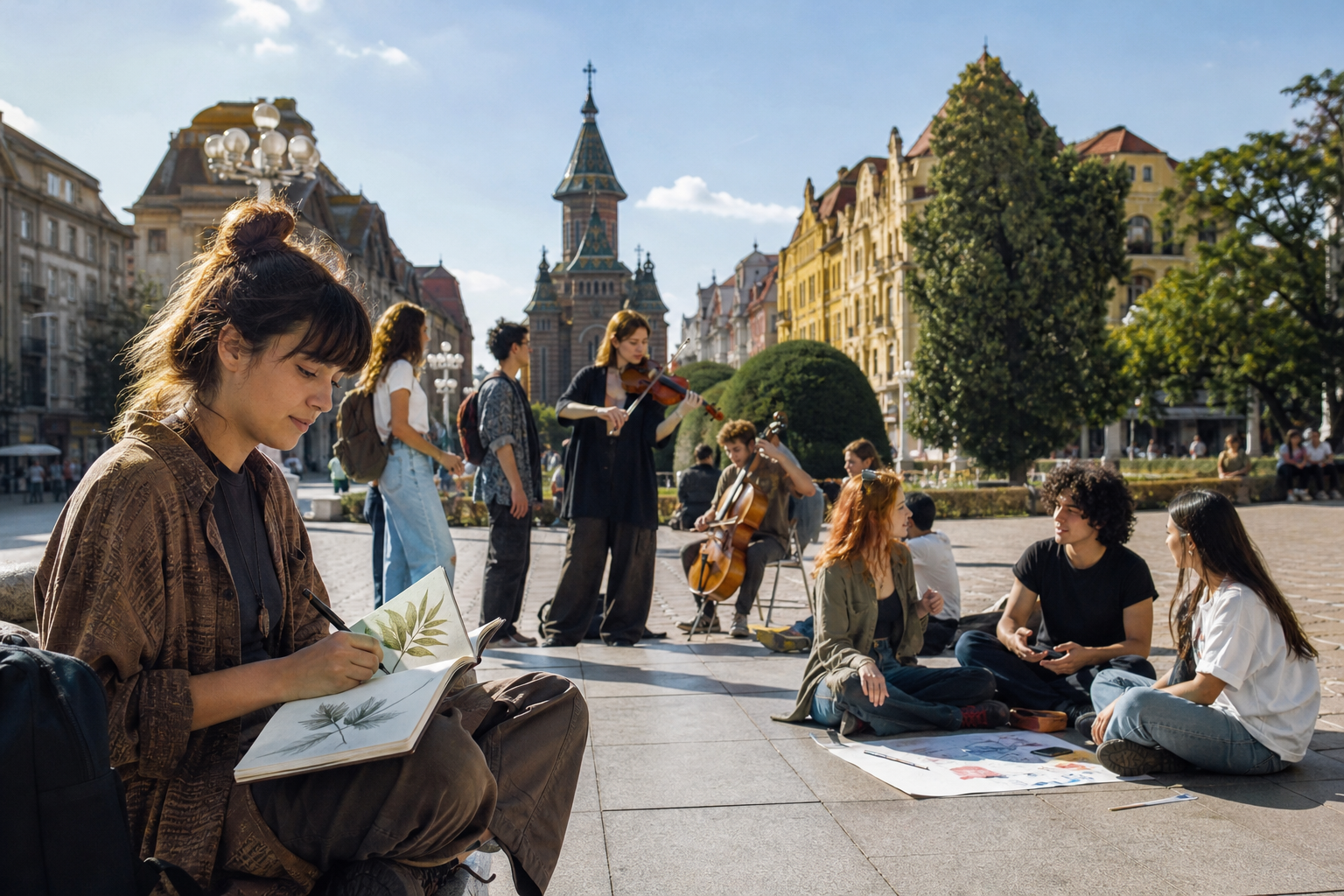
Cannabis culture in Timișoara is best understood as a mix of law, public-health awareness, youth culture, online discussion, hemp commerce and changing attitudes—not as a single organized scene. Timișoara is a university city with a strong arts community, an international population and a lively civic life, so conversations about cannabis often appear alongside wider debates about personal freedom, health, nightlife and regulation.
For residents and visitors, the most important distinction is between cultural visibility and legal permission. Seeing cannabis discussed in music, fashion or social media does not mean that possession, sale or consumption is lawful in Romania. This guide explains the local context without glamorizing illegal drug use, and separates cannabis, industrial hemp, CBD products and prescribed medicines.
Cannabis culture in Timișoara: what the phrase really describes
The phrase can refer to several overlapping ideas. It may describe informal conversations among students and creatives, interest in cannabis policy, advocacy for reform, legal hemp products, CBD-focused wellness marketing or concern about the risks associated with unregulated substances. These are not interchangeable categories.
Timișoara’s cultural identity also matters. The city’s festivals, independent venues, universities and cross-border connections create spaces where international trends arrive quickly. Discussions that are common in other European cities may therefore be visible online or in social settings even when Romanian law remains restrictive. Visibility should not be confused with a regulated recreational market.
Culture is not the same as a cannabis marketplace
There is no general legal recreational cannabis market in Romania. Informal offers, delivery claims and social-media advertisements can expose people to legal risk, fraud, adulterated products or substances that are inaccurately labelled. A seller’s claim that a product is “natural,” “strong” or “legal” is not proof of its composition or legal status.
People searching for weed in Timișoara should be especially cautious about anonymous listings and requests for advance payment. Avoiding illegal purchases is the safest option. No online description can reliably establish a product’s contents, potency or origin.
Cannabis laws in Timișoara and Romania
Timișoara follows national Romanian law rather than having a separate city cannabis code. Cannabis and cannabis resin are controlled substances, and unauthorized possession, distribution, cultivation and trafficking can carry serious consequences. The exact legal outcome depends on the substance, conduct, quantity, evidence and circumstances, so general internet summaries should not be treated as personal legal advice.
For official institutional information, consult the European Union Drugs Agency’s country and drug-policy resources and Romanian authorities. If you are involved in a police investigation, a Romanian lawyer is the appropriate source for advice about your specific situation.
- Do not assume that a small amount is automatically permitted.
- Do not carry cannabis across the Romanian border, including between Romania and neighboring countries.
- Do not drive after using cannabis or any intoxicating substance.
- Do not assume that a product sold as CBD is automatically compliant.
- Do not rely on a foreign prescription or another country’s rules without checking Romanian requirements.
These principles apply equally to residents, international students and tourists. A visitor’s unfamiliarity with Romanian law is not a dependable defense, and crossing a border can create additional legal complications.
CBD, hemp and cannabis: important distinctions
Industrial hemp is cultivated for regulated uses such as fiber, seed and certain food products. CBD is a non-intoxicating cannabinoid often marketed in oils, cosmetics and other formulations, but the legality of a specific product depends on its ingredients, intended use, THC content, labeling and compliance with applicable rules. Cannabis containing controlled levels of THC is a different legal and pharmacological category.
Consumers interested in cannabis in Timișoara should read the label carefully and preserve the receipt and packaging. Look for a clearly identified manufacturer, batch information, ingredients and instructions. Avoid products that promise to cure serious illnesses, hide laboratory information or use vague claims about being “100% legal.”
Food, cosmetics, supplements and medicines can be regulated under different frameworks. A product being available in a shop or on a website does not prove that every formulation is lawful or medically effective. The National Agency for Medicines and Medical Devices of Romania is a useful official starting point for questions about authorized medicines and medicine-related regulation.
For broader context on hemp products, the existing guide to hemp in Constanța and Romanian product rules offers a comparable Romanian perspective. It should still be read alongside current official guidance, because product rules and enforcement practices can change.
Medical cannabis in Timișoara: access and expectations
Medical cannabis in Timișoara is not equivalent to buying recreational cannabis or ordering an unverified oil online. Access to cannabinoid-based treatment depends on the medicine, authorization status, prescribing rules and the patient’s clinical circumstances. Romanian patients should discuss symptoms with a licensed doctor rather than self-medicating or treating online anecdotes as medical evidence.
A doctor may recommend an authorized treatment when clinically appropriate, but that does not mean every cannabis-derived product is a medicine. Patients should ask precise questions about the active ingredient, expected benefit, side effects, interactions, driving restrictions and monitoring. People already taking sedatives, antidepressants, seizure medicines, anticoagulants or other prescriptions should disclose this before using any cannabinoid product.
Questions patients should ask
- Is the product an authorized medicine or a general consumer product?
- What is the evidence for its proposed use?
- Could it cause drowsiness, anxiety, impaired concentration or interactions?
- How should unused medicine be stored and disposed of?
- Could using it affect driving, workplace duties or travel?
Patients can also compare the discussion with the practical overview of marijuana laws, safety and medical access in Cluj-Napoca. The cities share the national legal framework, although healthcare availability and individual clinical pathways may differ.
Students, nightlife and public health
Because Timișoara has a substantial student population and an active nightlife, prevention messages should focus on practical safety rather than judgment. Cannabis can affect reaction time, attention, memory, anxiety and coordination. Effects may be stronger or less predictable when products are high in THC, when a person is inexperienced or when cannabis is combined with alcohol or other drugs.
Harm reduction does not make illegal use legal. It means reducing immediate danger and encouraging timely help. Anyone who feels severely confused, has chest pain, difficulty breathing, a seizure, loss of consciousness or extreme agitation should contact emergency services. Do not leave an unwell person alone or encourage them to consume more substances.
- Never drive, cycle in traffic or operate machinery while impaired.
- Avoid mixing cannabis with alcohol or other intoxicants.
- Do not accept an unknown edible, vape liquid or concentrate.
- Keep products away from children and pets.
- Seek medical help for severe or unusual symptoms.
Edibles deserve particular caution because their effects can take longer to appear and may last longer than expected. Vaping unknown liquids can also introduce risks unrelated to cannabis itself, including contamination or harmful additives.
How Timișoara’s public conversation may evolve
Local cannabis culture is likely to continue developing through policy debates, health education, research, hemp businesses and creative expression. A more informed conversation should distinguish personal stories from clinical evidence and distinguish reform proposals from current law. It should also include people affected by dependence, mental-health difficulties, impaired driving and unequal access to care.
Community discussion is most useful when it avoids two extremes: presenting cannabis as harmless in every situation or treating every user as a criminal stereotype. Responsible reporting and advocacy can acknowledge potential therapeutic applications while discussing uncertainty, contraindications and the limits of current access.
What responsible local coverage should include
- Clear references to Romanian national law rather than assumptions based on another country.
- A distinction between THC, CBD, industrial hemp and authorized medicines.
- Practical information about impairment, interactions and emergency support.
- Respect for privacy when discussing patients, students or people facing legal proceedings.
- Updates from official institutions instead of relying solely on social-media claims.
Practical guidance for residents and visitors
If you are visiting Timișoara, do not bring cannabis across the border, even if it was purchased legally where you started your journey. Do not carry another person’s package, and do not assume that a prescription, membership card or product label from another country has legal effect in Romania.
Residents considering CBD or hemp products should purchase only from transparent suppliers and retain documentation. If a product produces unexpected intoxication, stop using it and seek medical advice. If you are worried about your own use, confidentially speaking with a doctor or addiction-support service is more constructive than waiting for a crisis.
Anyone facing a legal problem should avoid posting details publicly and obtain advice from a qualified Romanian attorney. Online forums can explain how people perceive cannabis laws in Timișoara, but they cannot replace current legislation or professional advice.
Conclusion
Cannabis culture in Timișoara reflects a modern European city’s mix of curiosity, creativity, commerce, health concerns and policy debate. Yet the legal baseline remains national Romanian law, and cultural openness does not create a legal recreational market. The safest approach is to distinguish cannabis from hemp and CBD, verify medical information with licensed professionals, avoid unknown products and never drive while impaired.
A responsible understanding of medical cannabis in Timișoara also requires patience: access, authorization and evidence are different questions. By combining accurate legal information with public-health awareness and respect for individual circumstances, residents and visitors can discuss the subject without encouraging unsafe or unlawful behavior.