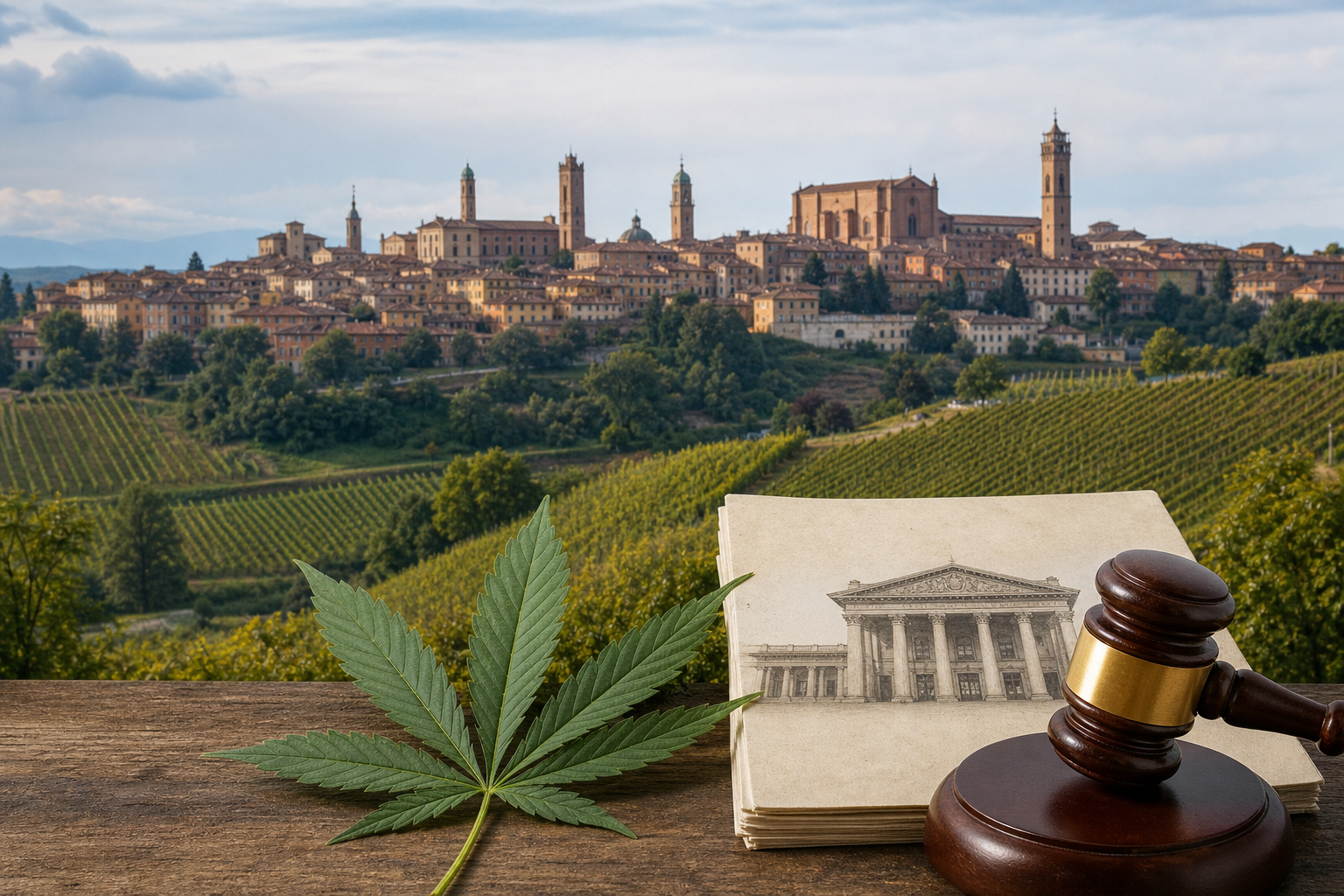
Cannabis decriminalization in Alba, Italy is often misunderstood. Italy does not treat cannabis as fully legal, and Alba cannot independently legalize or decriminalize conduct covered by national law. Instead, Italian rules distinguish between personal possession, which may lead to administrative consequences, and activities such as selling, supplying or large-scale cultivation, which can be criminal offenses.
This guide explains how the national framework applies in Alba, what residents and visitors should understand about possession and consumption, and why location-specific assumptions can be misleading. The practical message is simple: limited personal possession is not the same as permission to buy, sell or use cannabis without legal risk.
What cannabis decriminalization in Alba, Italy actually means
Italy’s principal drug legislation is based on Presidential Decree No. 309 of 1990. Under Article 75, acquiring, possessing or carrying a controlled substance for personal use can result in administrative sanctions rather than a criminal conviction. Cannabis is generally addressed within this framework, although the exact outcome depends on the facts, the substance involved and the authorities’ assessment.
Decriminalization changes the type of legal response; it does not create a regulated recreational market. A person may avoid criminal prosecution for a personal-use case and still face an official procedure, questioning, seizure of the substance or restrictions affecting documents and driving privileges.
The distinction is important for anyone searching for cannabis in Alba. There is no general legal retail system for recreational cannabis in the town. A product being offered informally, described as “light” or sold through an online channel does not automatically make the transaction lawful.
Administrative treatment is not legalization
Administrative consequences are handled through the relevant public authorities rather than functioning like an ordinary retail regulation. Depending on the circumstances, a person may be referred to the prefecture, where the case can be assessed and sanctions considered. The response may vary according to the quantity, the suspected purpose, previous incidents and other evidence.
Authorities do not have to accept a person’s statement that cannabis was intended only for personal use. Packaging, messages, scales, multiple packets, cash and other surrounding facts may influence how the conduct is classified. A case that appears small at first can become more serious if investigators believe it involves supply or distribution.
Cannabis laws in Alba: possession, supply and cultivation
Personal possession
Personal possession is the area most often described as “decriminalized.” In practical terms, a person found with a limited amount may face an administrative process instead of a criminal drug-trafficking charge. The substance can still be confiscated, and the person may be required to respond to official notices or attend an interview.
There is no universally safe amount that guarantees a particular result. Italian drug law uses criteria relating to personal use, and authorities consider the complete situation rather than relying on a simple public “allowance.” Quantity alone is not always decisive. The form of the substance and evidence about its intended use may also matter.
Sale, sharing and supply
Selling cannabis is not protected by personal-use decriminalization. The same caution applies to giving cannabis to another person, arranging a transaction, holding it for someone else or transporting it for distribution. These activities may be investigated under the criminal provisions of Italian drug law.
Sharing a small amount with a friend can still create legal exposure because the law does not treat informal supply as equivalent to personal possession. Visitors should be especially careful about carrying cannabis for another person or accepting a package without knowing its contents.
Home cultivation
Home cultivation is legally complex. Italian courts, including the Constitutional Court, have recognized a narrow possibility for limited cultivation exclusively intended for the grower’s personal use when the cultivation is rudimentary and does not meaningfully affect the public drug market. That principle is fact-specific and does not amount to a broad right to grow cannabis at home.
The number of plants, cultivation equipment, yield, security arrangements and evidence of intended distribution can all be relevant. A commercial-style indoor operation, cultivation for friends or any sale-related activity presents substantially greater risk. Anyone facing a cultivation allegation should obtain advice from an Italian criminal lawyer rather than relying on general internet summaries.
Using cannabis in Alba: public places, private homes and travel
Decriminalization of personal possession does not create a right to consume cannabis wherever a person chooses. Using cannabis in a street, piazza, park, restaurant, hotel common area or near other members of the public can lead to intervention under applicable public-order, nuisance or health-and-safety rules. Property owners and businesses can also prohibit smoking on their premises.
Even when possession is dealt with administratively, public consumption may create additional problems. Smoke, disturbance, trespass, conduct around children or use near sensitive locations can attract attention independently of the drug-possession issue. The safest legal approach is not to consume in public and to respect the rules of private accommodation.
For people researching weed in Alba, travel is another major boundary. Carrying cannabis across an international border is not comparable to possessing a small amount for personal use inside Italy. Importing or exporting controlled substances can trigger serious criminal consequences, even if the quantity is modest or the substance was lawfully purchased elsewhere.
Do not place cannabis in checked or hand luggage, and do not assume that a medical authorization from another country automatically permits entry into Italy. Cross-border rules depend on the substance, documentation and countries involved.
Driving after cannabis use
Driving after using cannabis is a separate and potentially serious issue. Italian road-traffic rules can impose penalties when drivers are found to be operating a vehicle after taking drugs, and roadside or medical testing may become relevant. The fact that cannabis possession itself is treated administratively does not make driving after use acceptable.
Impairment is also a practical safety concern. Cannabis can affect reaction time, attention, coordination and judgment. A person who has consumed cannabis should not drive, cycle in traffic or operate machinery. Public transport, a sober driver or postponing travel is safer than attempting to judge whether the effects have “worn off.”
Drivers should also understand that a positive test or investigation may involve legal questions different from the original possession matter. If stopped or tested, avoid arguing about legal interpretations at the roadside and seek qualified legal advice if authorities begin formal proceedings.
Medical cannabis in Alba
Italy permits certain cannabis-based medicines and preparations within the healthcare system. Access generally depends on a medical assessment, an appropriate prescription and dispensing through authorized channels, such as a pharmacy. Medical cannabis is not a general authorization to purchase recreational cannabis or to grow and carry unlimited quantities.
Patients should keep medication in its original packaging and carry the prescription or supporting medical documentation when travelling within Italy. They should also ask their doctor or pharmacist about dosage, driving, interactions and the rules for travelling across borders.
Anyone looking for medical cannabis in Alba should begin with a licensed physician or pharmacist. Online sellers making broad therapeutic claims may not be authorized, and products marketed as supplements are not necessarily equivalent to prescribed medical preparations. For general national health information, consult the Italian Ministry of Health.
What visitors should know about cannabis in Alba
Alba is a town in Piedmont, but cannabis rules are established principally at the national level. Local police and public authorities apply those rules; they do not operate a separate recreational cannabis regime for tourists. A relaxed atmosphere, a festival, a private rental or a local suggestion is not a legal defense.
- Do not buy cannabis from street sellers or informal contacts.
- Do not carry cannabis for another person.
- Do not consume in public places or inside accommodation where the owner prohibits it.
- Never drive after using cannabis.
- Do not take cannabis across the Italian border.
- If stopped, remain calm and ask for an interpreter or lawyer when needed.
Visitors comparing nearby destinations may also find it useful to read this overview of cannabis legalization in Ivrea. The key point is that neighboring towns do not create separate recreational laws: the national framework remains central.
What happens after a possession stop?
Police may identify the person, seize and document the substance, and forward information to the competent authority. The person may later receive instructions or a notification concerning an administrative proceeding. The outcome can depend on the quantity, the substance analysis, prior history and whether officials identify indications of supply.
Do not ignore official correspondence. Missing a deadline or appointment can make the situation harder to manage. A person who does not understand Italian should request language assistance and should consider speaking with a qualified lawyer familiar with Italian drug and administrative procedures.
For the official legal text, readers can consult the relevant entry for Italy’s Presidential Decree No. 309 of 1990. Legal provisions and enforcement practices can change, so current professional advice is preferable to relying on an old article or social-media post.
How to interpret the law responsibly
The phrase “decriminalized” can create a false sense of security. In Alba, it is more accurate to say that some personal-use conduct may be handled through administrative sanctions rather than criminal prosecution. That limited distinction does not legalize recreational sales, public consumption, impaired driving, border crossings or commercial cultivation.
For residents, the most sensible approach is to avoid informal supply and seek professional advice when a prescription, cultivation question or police notice is involved. For visitors, the safest option is not to buy, carry, consume or transport cannabis during a trip unless they have confirmed that their specific medical and travel circumstances comply with Italian law.
Conclusion
Cannabis decriminalization in Alba, Italy describes a narrow legal distinction, not a free-use policy. Personal possession may lead to administrative consequences, while supply, trafficking and many cultivation situations can remain criminal matters. Public use, driving after consumption and international travel create additional risks.
Because outcomes depend on the facts and the law can develop through legislation and court decisions, this article is general information rather than legal advice. When an incident has already occurred, contacting an Italian lawyer promptly is the most reliable way to understand the available options.