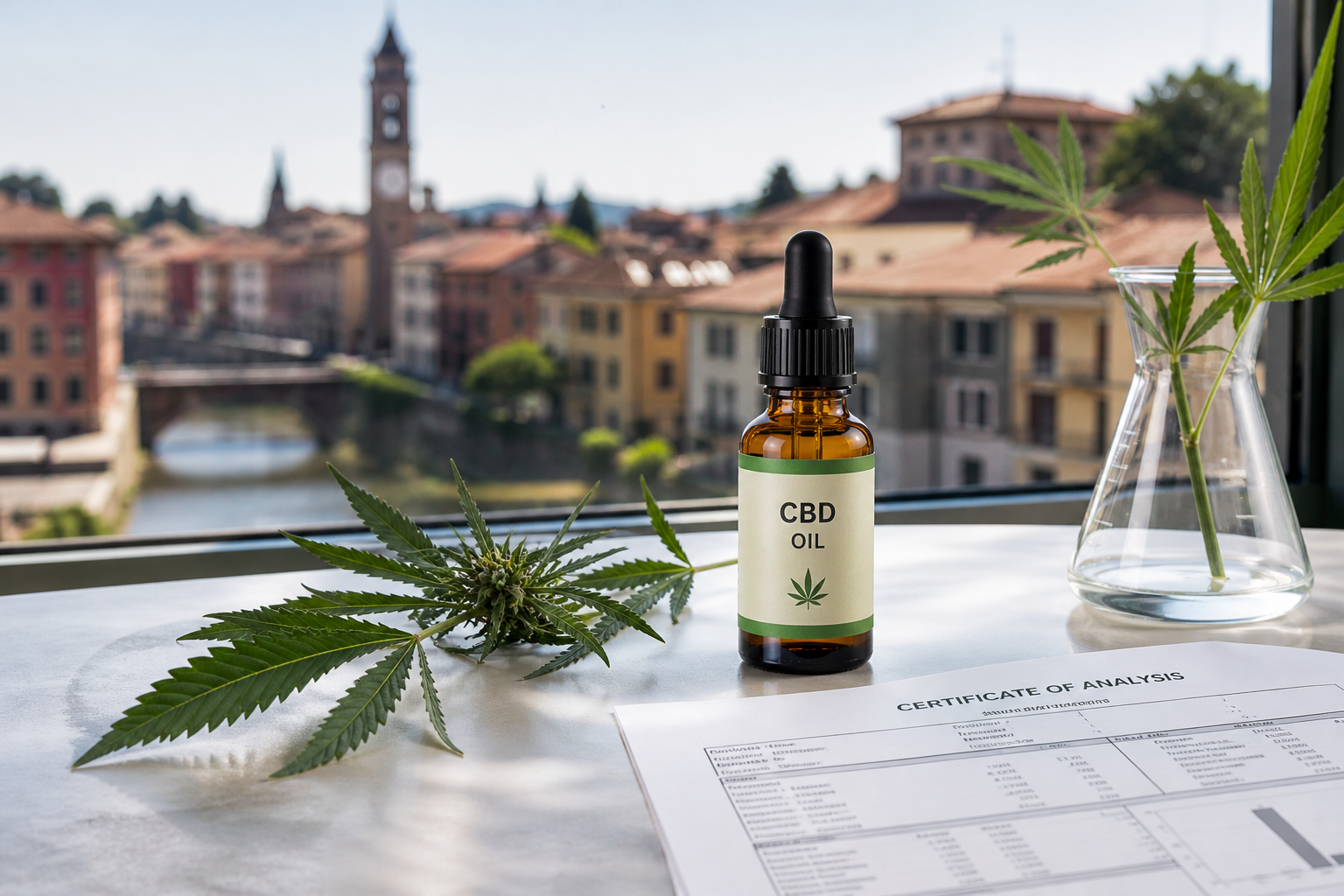
This CBD guide 2026 Magenta Italy is designed for residents, visitors and shoppers who want a clear overview of cannabidiol products in Magenta and the surrounding Milan metropolitan area. It explains what CBD is, how Italian rules differ according to the product, what to check before buying, and why medical cannabis should not be confused with ordinary wellness products.
CBD is not the same as THC. Cannabidiol is generally non-intoxicating, while THC is the cannabinoid associated with the classic psychoactive effect of cannabis. That distinction is important, but it does not mean every CBD product is automatically legal, suitable or risk-free. Product composition, intended use, labelling, possession and transport can all matter.
CBD in Magenta: what shoppers should know first
Magenta is in the Metropolitan City of Milan, where CBD products may be encountered through specialist retailers, pharmacies, wellness businesses and online sellers. Availability alone does not prove that a product complies with Italian law. A shop listing, social-media advertisement or marketplace description is not a substitute for proper labelling and a current regulatory check.
The safest starting point is to identify the product category. CBD oil sold as a cosmetic, a topical product, a food supplement, a food ingredient, a vape liquid or a medicinal preparation may be subject to different requirements. A product intended to be swallowed should not automatically be treated like a skin cream, and a CBD flower product should not automatically be treated like an ordinary hemp seed product.
For wider local context, readers can also compare this overview with the guide to cannabis facts in nearby Parabiago. Local geography may be useful for orientation, but national Italian rules remain the central issue.
CBD laws in Italy in 2026
Italian CBD regulation is not one simple rule covering every item labelled “CBD.” The legal position can depend on the amount and form of THC, the plant material used, the product’s presentation, and whether it is intended for food, cosmetic, therapeutic or other use. Rules and enforcement positions can also change, so a product that appears widely available should still be assessed carefully.
For official public-health information, consult the Italian Ministry of Health. For customs and excise-related information, the Italian Customs and Monopolies Agency is an appropriate official reference point. These institutions are more reliable than retailer claims when checking current requirements.
Why THC content matters
Even when a product is marketed as CBD, trace THC may be present. THC can create legal, practical and employment-related concerns, particularly for people subject to drug testing or professional safety rules. “THC-free” should therefore be supported by a recent independent certificate of analysis rather than accepted solely because it appears in an advertisement.
Italian and European rules may also treat cannabis flowers, extracts and ingestible products differently. The legal status of low-THC hemp flower and products made from it has been especially sensitive to regulatory developments. Do not assume that a low-THC label guarantees that possession, sale, use or transport is permitted in every situation.
Food, supplements and novel-food concerns
CBD products intended to be eaten or swallowed require extra caution. Food and supplement rules are separate from cosmetic rules, and CBD foods have been subject to novel-food discussions and regulatory scrutiny in the European Union. A product being sold online does not prove that it has the necessary authorisation for the intended market.
Before buying an ingestible product, check whether the seller identifies the responsible business operator, provides an Italian or EU-compliant label, states the serving information and gives a batch-specific laboratory report. Avoid products that make guaranteed claims about anxiety, pain, sleep, inflammation or disease treatment.
Choosing CBD products in Magenta
When comparing CBD products in Magenta, focus on evidence of quality rather than packaging, influencer recommendations or unusually strong promises. A responsible seller should be able to explain the product category, ingredients, cannabinoid content and recommended use without presenting CBD as a cure.
- Read the full ingredient list: Look for the carrier oil, flavourings, allergens, preservatives and any added cannabinoids.
- Check the CBD amount: The total quantity and concentration should be clear, not hidden behind vague phrases such as “maximum strength.”
- Look for batch testing: A certificate of analysis should identify the tested batch and show CBD, THC, contaminants and testing methods where available.
- Check the responsible seller: Look for a business name, physical address, customer-service details and clear product documentation.
- Inspect the packaging: Seals, expiry information, lot numbers and storage instructions are basic quality signals.
- Be cautious with medical promises: Claims that a product replaces prescribed treatment are a serious warning sign.
Oils, capsules, cosmetics and flowers
CBD oils and capsules are usually ingested, so their safety and legal assessment is different from that of a cream or balm. Topical cosmetics are applied to the skin, but they can still contain allergens or irritants and should not be used on damaged skin unless the label supports that use.
CBD flower deserves particular caution. Its appearance and smell can resemble cannabis, and possession or transport may create questions even if the seller describes it as legal hemp. It should never be smoked in public places simply because it is marketed as low THC. Public-use rules, nuisance provisions and local restrictions can apply independently of the product’s advertised cannabinoid content.
CBD, medical cannabis and prescriptions
CBD sold as a wellness product is not the same as medical cannabis prescribed through the Italian healthcare system. Medical cannabis may contain THC and is used under medical supervision for specific clinical circumstances. Patients should follow the prescription, pharmacy instructions and travel documentation requirements rather than substituting an unregulated CBD product.
People considering cannabinoids for pain, sleep, epilepsy, anxiety or another health concern should speak with a doctor or pharmacist, especially if they already take medication. A useful nearby comparison is this patient-focused overview of medical cannabis in Peschiera Borromeo, although individual treatment decisions still require a qualified clinician.
Possible side effects and interactions
CBD may cause unwanted effects such as drowsiness, digestive discomfort, changes in appetite or fatigue. It may also interact with medicines that are processed by the liver. The risk can be more important for people taking several prescriptions or medicines with a narrow safety margin.
Do not drive, cycle in traffic or operate machinery until you know how a product affects you. Avoid combining CBD with alcohol or sedating substances. Pregnant or breastfeeding people, children, older adults and anyone with significant liver disease should obtain professional advice before using CBD.
Buying CBD in Magenta and shopping online
A local purchase can make it easier to ask questions and inspect packaging, but it does not remove the need for due diligence. Ask whether the seller can provide a current certificate of analysis and whether the product is intended for topical, cosmetic, food or another use. If staff cannot explain the ingredients or THC testing, choose a different product.
Online shopping requires additional checks. Confirm that the seller clearly states where the business is based, which country receives the order, how returns work and whether the product is legally marketed in Italy. Be particularly careful with websites that ship from outside the European Union, use anonymous contact details or make dramatic health claims.
Keep the original packaging and purchase record. This is useful if you need to identify a batch, report an adverse reaction or explain the contents during a journey. Store products securely away from children and pets, and follow the label’s temperature and light instructions.
Travelling with CBD from Magenta
Taking CBD across borders can be more complicated than buying it locally. Countries differ in how they define hemp, CBD extracts, THC thresholds, medicines and food products. A product lawful in Italy may still cause problems in another country, particularly if it contains detectable THC or resembles cannabis flower.
Before travelling, check the destination country’s official rules and consider whether carrying the product is necessary. Do not place unlabelled oils, loose flowers or capsules into hand luggage. For prescribed medical cannabis, carry the original prescription, medical documentation and any required permit; ordinary CBD products should not be presented as prescribed medicine.
Within Italy, transport does not automatically make a product lawful. Keep it in its original sealed packaging and avoid carrying products with unclear labels or no proof of composition. If you are unsure, do not travel with it until you have obtained reliable legal guidance.
Common mistakes to avoid
- Assuming “natural” means risk-free: Hemp-derived ingredients can still interact with medicines or contain contaminants.
- Confusing CBD with medical cannabis: A wellness product is not a prescription and should not replace clinical care.
- Relying on a retailer’s THC statement: Ask for batch-specific testing when THC exposure matters.
- Ignoring intended use: Rules for cosmetics, foods, vapes and plant material may differ.
- Buying the strongest product first: Higher concentration does not necessarily mean better results or better value.
- Making unsupported health claims: CBD should not be advertised or used as a guaranteed treatment for disease.
A practical checklist for CBD in Magenta
Before purchasing or using a product, work through this short checklist:
- What exactly is the product: cosmetic, food, oil, vape, flower or medicine?
- Does the label state CBD and THC content clearly?
- Is there a recent, batch-specific certificate of analysis?
- Are the ingredients, expiry date and responsible business operator identified?
- Could CBD interact with your medicines or affect driving?
- Are you taking the product across a regional or international border?
- Have you checked current official guidance rather than relying on an old blog post?
Conclusion
The most useful lesson from this CBD guide 2026 Magenta Italy is that legality and safety depend on the complete product and its intended use, not simply on the word “CBD” on the label. Choose transparent sellers, verify cannabinoid content, avoid unsupported medical claims and seek advice from a doctor or pharmacist when medicines or health conditions are involved.
For 2026, treat CBD rules as a developing area. Check official Italian information before buying ingestible products, carrying CBD across borders or relying on a product for a medical purpose. Careful research is more dependable than assumptions based on availability, advertising or product popularity.