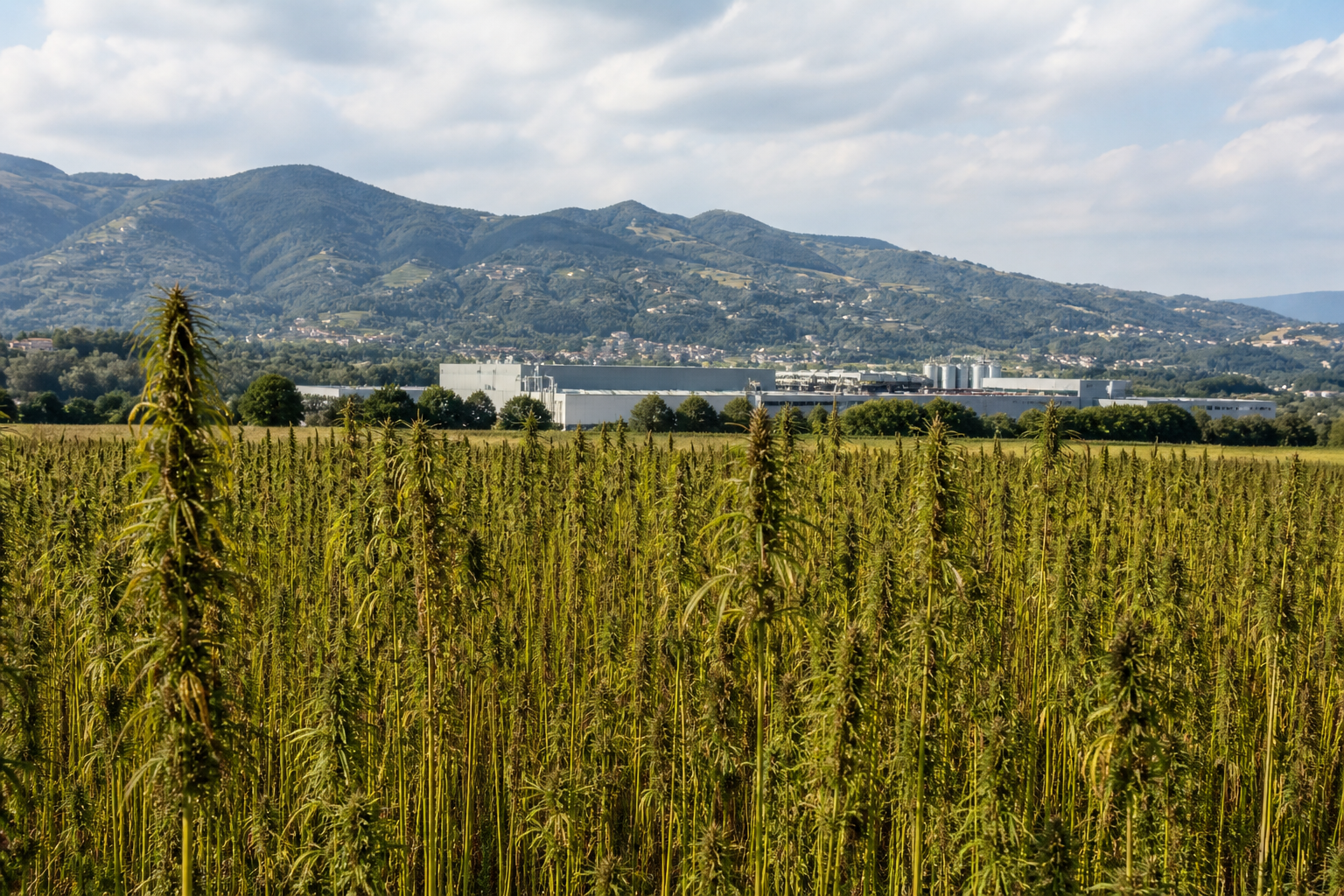
The hemp industry in Vicenza, Italy sits at the intersection of the province’s agricultural knowledge, manufacturing heritage and interest in sustainable materials. Hemp is not a single-product market. Depending on the variety and processing method, the crop can supply fibre, hurd, seed, food ingredients, building materials, cosmetics and other industrial inputs.
Vicenza is not usually described as Italy’s main hemp-growing centre, and reliable public data does not always separate provincial hemp activity from broader regional agriculture. Even so, the area has characteristics that may support a carefully developed supply chain: productive farmland, an established textile and manufacturing culture, logistics connections and businesses experienced in transforming raw materials into finished goods. Understanding the sector requires a clear distinction between lawful industrial hemp and controlled cannabis products.
Why the hemp industry in Vicenza, Italy, is attracting attention
Interest in industrial hemp in Vicenza is closely connected to the search for renewable raw materials. Hemp grows relatively quickly and can be used in several markets, which gives farmers and processors more than one potential revenue route. However, environmental benefits depend on local growing conditions, water use, inputs, transport and what happens after harvest. Hemp should not be presented as automatically sustainable in every situation.
Vicenza’s economic profile may also be relevant. The province is known for manufacturing, design, small and medium-sized enterprises and specialist production. Those capabilities could support hemp-related work beyond cultivation, such as fibre preparation, yarn development, packaging, composite materials, laboratory testing, product design and distribution. In practice, the strongest opportunities may come from cooperation between farmers, processors, researchers and established manufacturers rather than from isolated retail activity.
A supply chain rather than a single business
A functioning hemp economy normally includes several stages:
- Selection of suitable, legally permitted seed and cultivation sites.
- Field management, harvesting and safe storage of plant material.
- Primary processing, including separation of fibre, hurd and seed.
- Laboratory checks and documentation for relevant products.
- Manufacturing into textiles, insulation, foods, cosmetics or technical materials.
- Distribution through specialist wholesalers, retailers and business-to-business channels.
Each stage has different costs and compliance needs. A farmer may be interested in agronomy, while a textile company needs consistent fibre length and quality. A food producer requires traceability and appropriate testing. This is why local hemp development depends on coordination, not simply on planting more acreage.
Industrial hemp in Vicenza: possible applications
Textiles and fibre products
Hemp fibre is one of the most recognizable uses of the plant. It can be blended with other fibres or processed for fabrics, technical textiles, household goods and accessories. Vicenza’s wider manufacturing ecosystem could make textile experimentation particularly relevant, although fibre quality, retting, spinning capacity and cost remain practical challenges.
Hemp textiles are often marketed for durability and natural appeal, but buyers should look for clear information about fibre composition, processing and finishing. A product described as hemp may contain a blend rather than pure hemp fibre. Transparent labelling helps consumers compare products without confusing environmental claims with independently verified performance.
Construction and composite materials
The woody inner part of the stalk, commonly called hurd or shiv, can be used in certain insulation and building applications. Hemp-lime materials, panels and biocomposites are examples of areas that attract interest from sustainable construction projects. Their suitability depends on building design, technical specifications, moisture management, fire performance and local building rules.
For Vicenza businesses, the opportunity may be strongest in specialist materials rather than informal do-it-yourself products. Architects, contractors and manufacturers need documented performance and installation guidance. Demonstration projects can help show where hemp-based materials are appropriate while avoiding exaggerated claims about energy savings or carbon storage.
Food, seed and personal-care products
Hemp seeds and seed-derived ingredients are used in foods such as oils, flour and protein products. These markets are separate from intoxicating cannabis and should be assessed through food-safety and labelling requirements. Cosmetics may use hemp seed oil or other permitted ingredients, but product claims must still comply with applicable rules.
Consumers in Vicenza may encounter hemp products in health-food shops, specialist retailers and online stores. A responsible buyer should check the ingredient list, producer details, batch information and intended use. Marketing language alone is not proof of quality, legality or medical effectiveness.
Hemp farming in Veneto and the Vicenza area
Hemp farming in Veneto must be considered within normal agricultural planning. Soil, climate, rotation, harvesting equipment and access to a processor all influence whether a crop is commercially sensible. A farmer located far from a decortication or processing facility may face transport costs that undermine the project, even if the crop grows successfully.
Before planting, growers should confirm the status of the seed, retain purchase and cultivation records, and consult the relevant Italian authorities or agricultural professionals. The European Commission provides background on European hemp rules and agricultural requirements, while Italy’s Ministry of Agriculture, Food Sovereignty and Forestry is an important institutional source for national agricultural information.
Rotation planning also matters. Hemp can fit into some diversified farming systems, but it is not a universal substitute for other crops. Farmers should evaluate machinery access, harvest timing, potential buyers and contracts before making a commercial decision. Small pilot plots may be more appropriate than immediate large-scale planting.
Regulation and cannabis laws in Vicenza
The phrase cannabis laws in Vicenza can refer to several different subjects, including cultivation, industrial hemp, food, cosmetics, CBD products, medical cannabis and recreational possession. These areas should not be treated as interchangeable. Rules can depend on the plant material, THC content, intended use, product formulation, labelling and the applicable national or European framework.
Italian Law 242/2016 established an important framework for the cultivation and supply of certain industrial hemp varieties, but the commercial status of flowers, extracts and consumer products has been subject to legal interpretation and regulatory change. Businesses should obtain current professional advice rather than relying on old articles, informal seller claims or assumptions based on another country.
For official updates and institutional guidance, businesses can consult the Italian Ministry of Agriculture, Food Sovereignty and Forestry. Companies should also review requirements from other relevant authorities depending on the product category, including food, cosmetics, medicines, workplace safety, packaging and consumer protection bodies.
Practical compliance questions for businesses
- Is the proposed crop or product clearly within the applicable industrial hemp framework?
- Can the supplier provide seed, batch and traceability documentation?
- Are testing methods and laboratories appropriate for the product?
- Does the label accurately describe ingredients, use and warnings?
- Are health, therapeutic or performance claims legally permitted and properly supported?
- Does the business need additional registration, authorisation or specialist insurance?
These questions are especially important for hemp products in Vicenza sold across regional or national markets. A product that appears acceptable in a shop may still create compliance problems if its advertising, formulation or documentation is incomplete.
Local business opportunities and barriers
The most realistic opportunities may be found in value-added activities. A Vicenza company could develop hemp-based packaging, work with textile manufacturers on blends, supply building materials, provide testing or create traceable food products. Existing expertise in engineering, design and industrial production can be more valuable than simply competing on raw crop volume.
There are also significant barriers. Processing infrastructure is specialised, demand can be inconsistent and farmers may lack guaranteed buyers. Hemp products compete with established materials whose supply chains are already efficient. Regulatory uncertainty can make investment difficult, particularly in categories connected to extracts or consumer wellness.
Public communication is another challenge. The word hemp is sometimes used in ways that blur the line between industrial materials and psychoactive cannabis. Businesses that explain their ingredients, production methods and intended uses clearly are more likely to build trust. Educational partnerships with agricultural groups, universities and trade associations can support a more accurate local conversation.
How consumers can buy hemp products responsibly
People looking for hemp products in Vicenza should begin by identifying what they actually need: food, clothing, building material, cosmetics or another product. They should then compare ingredient information, origin, manufacturer details and instructions for use. For ingestible products, checking food labelling and allergen information is particularly important.
Consumers should be cautious of products promising to treat serious conditions, produce guaranteed effects or avoid all regulatory oversight. Hemp-derived does not automatically mean risk-free, and natural does not automatically mean effective. Anyone using medicines or considering a cannabinoid product for a health concern should speak with a qualified healthcare professional.
Those interested in wider Italian cannabis policy can also compare local context with the guide to cannabis policy in nearby Padua. For a broader industry perspective, the overview of marijuana industry issues in Latina illustrates why law, business models and product categories need to be discussed separately.
What could come next for Vicenza
Future growth will likely depend on evidence, infrastructure and stable rules. Pilot cultivation projects linked to confirmed buyers could reduce risk. Shared processing facilities could make smaller farms more viable, while product testing and traceability systems could improve confidence among manufacturers and consumers.
Research may also clarify which applications make sense locally. Instead of treating hemp as a universal solution, businesses can evaluate it against alternatives using measurable criteria such as durability, cost, recyclability, transport distance and end-of-life options. This approach gives Vicenza a more credible foundation for sustainable innovation.
Conclusion
The hemp industry in Vicenza, Italy, is best understood as an emerging network of agricultural, manufacturing and research possibilities rather than a single mature sector. Industrial hemp could contribute to textiles, construction materials, food, cosmetics and technical products, but success depends on suitable varieties, reliable processing, transparent testing and compliance with changing rules.
For farmers and businesses, the sensible path is gradual: verify the legal framework, identify a buyer, plan processing and document every stage. For consumers, clear labels and realistic claims matter more than fashionable marketing. With practical investment and accurate communication, Vicenza could participate in Italy’s hemp economy while keeping expectations grounded in evidence.