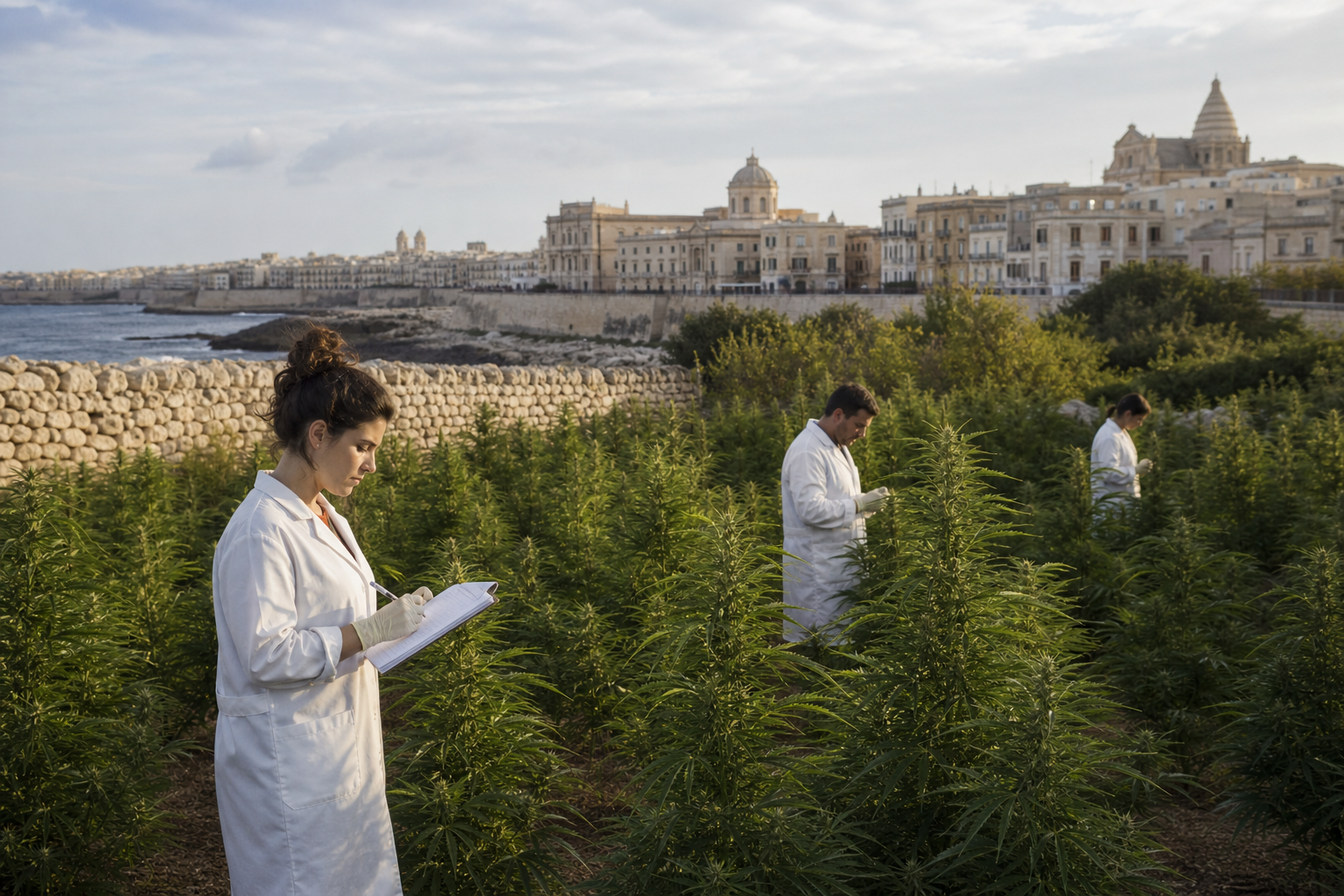
Cannabis research in Syracuse, Italy, sits at the intersection of medicine, public health, agriculture, law and local economic development. Syracuse is in southeastern Sicily, a region with important agricultural activity and a climate that naturally invites questions about hemp cultivation, plant science and sustainable production. At the same time, medical cannabis and recreational use are governed by national Italian rules rather than by a separate Syracuse cannabis system.
That distinction matters. A search for cannabis in Syracuse may return discussions about local access, CBD products, medical treatment or public attitudes, but these subjects are not interchangeable with scientific research. Reliable research requires a defined question, transparent methods and evidence that can be checked in an academic or institutional source. This guide explains the main research areas relevant to Syracuse and shows how residents, students and visitors can evaluate claims without confusing local interest with proof.
What cannabis research in Syracuse, Italy can include
There is no single field called cannabis research. The phrase can describe several forms of investigation, each with different methods and standards. A study involving a Sicilian farm, for example, will not answer the same question as a clinical trial involving a cannabinoid-based medicine.
- Clinical research: Studies whether cannabis-based medicines or individual cannabinoids may help with specific medical conditions, while also examining side effects, dose and interactions.
- Public health research: Examines patterns of use, dependence, impaired driving, youth exposure, emergency presentations and access to treatment.
- Agricultural research: Looks at hemp varieties, soil, irrigation, pests, harvesting, fibre and seed production, and the effect of local environmental conditions.
- Policy research: Assesses how laws, enforcement, prescribing systems and prevention programmes affect communities.
- Laboratory research: Investigates cannabinoids, terpenes, plant chemistry and possible biological mechanisms. Laboratory findings do not automatically establish that a product is safe or effective for people.
These categories can overlap, but they should not be blended casually. A promising laboratory result is an early scientific finding, not a recommendation to self-medicate. Similarly, a survey about attitudes toward weed in Syracuse is useful for understanding public opinion, but it does not measure the effectiveness of a treatment.
Why Syracuse and Sicily are relevant to the discussion
Syracuse offers a useful setting for questions about how national cannabis policy interacts with a distinct local environment. Southeastern Sicily has farming communities, coastal and inland landscapes, tourism, universities and healthcare services. Those characteristics can create research opportunities in agricultural science, prevention, environmental monitoring and health services.
However, geography alone does not prove that a particular study has been conducted in Syracuse. A product marketed as Sicilian, a local news report or a business announcement should not be described as peer-reviewed research unless the underlying publication or institutional record can be identified. When searching for cannabis studies in Sicily, readers should check the study location, authors, funding, sample size and publication status.
Some research questions may be regional rather than municipal. For example, a project could compare cultivation conditions across Sicily, analyse health data from a wider province or examine national prescribing patterns. Such work may be relevant to Syracuse while still not providing a city-specific result.
Local questions worth studying
Research connected to Syracuse could examine how residents understand medical cannabis, whether healthcare professionals receive adequate information, how hemp farmers interpret cultivation requirements, or how tourists encounter Italy’s restrictions. Other useful questions include the environmental effects of cultivation, the accuracy of cannabinoid product labels and the relationship between cannabis use and road safety.
These questions require different data. A health study might use anonymised clinical records, while an agricultural study might measure plant traits and soil conditions. A sound local project should explain its ethical approval, sampling approach and limitations rather than presenting anecdotal experience as representative evidence.
Medical cannabis research and access in Syracuse
Medical cannabis in Syracuse should be understood within Italy’s national healthcare and medicines framework. Medical use is not the same as general recreational availability, and a person should not assume that a product sold as CBD or hemp is equivalent to a prescribed cannabis preparation.
Clinical evidence is condition-specific. Research may support a possible role for certain cannabis-based medicines in narrowly defined circumstances, but results cannot automatically be extended to every cannabis product, dose or health complaint. Products may differ in their levels of THC, CBD, other cannabinoids, contaminants and manufacturing quality.
Anyone considering treatment should speak with a qualified doctor or pharmacist, especially when taking sedatives, anticoagulants, seizure medicines, antidepressants or other prescription drugs. Cannabis can affect alertness and coordination, and some people may experience anxiety, dizziness, cognitive effects or other adverse reactions. Pregnancy, adolescence, a history of psychosis and some cardiovascular conditions require particular caution and professional advice.
The Italian Ministry of Health is the appropriate starting point for official information about national health rules, medicines and public-health guidance. Its information should be read alongside advice from a healthcare professional, because online summaries cannot determine whether a treatment is suitable for an individual.
For broader background on legal categories and travel concerns, readers can also compare this topic with the Cannabis guide to Catania and Italian travel rules. Catania is not Syracuse, but the national framework discussed there is relevant across Italy.
Hemp, agriculture and environmental research
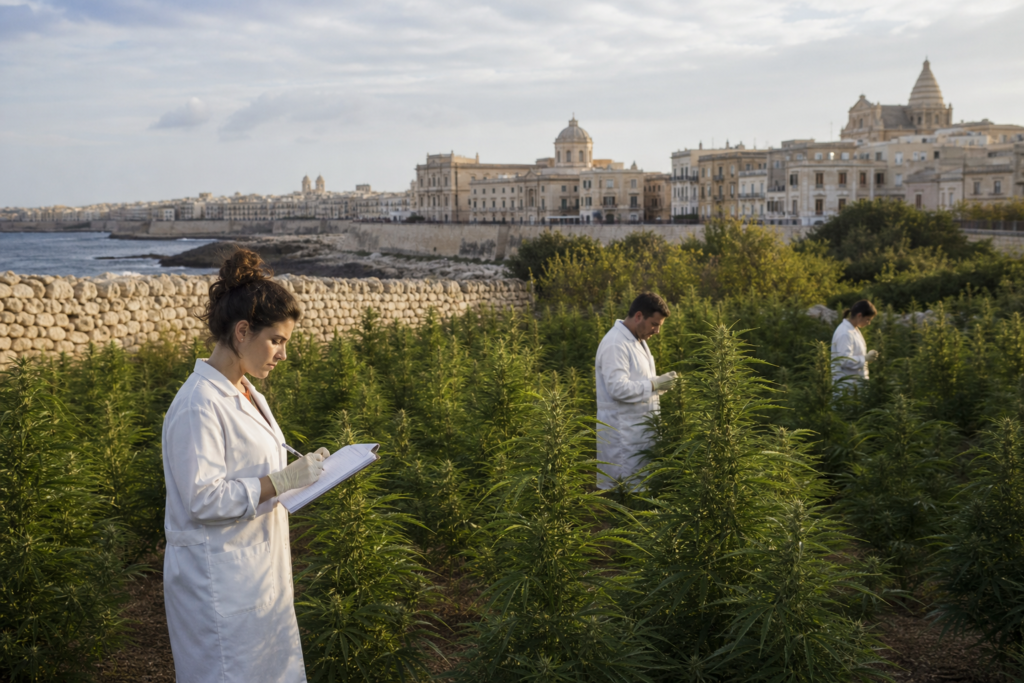
Hemp research is one of the most practical areas for a region with an agricultural economy. Researchers may study varieties bred for fibre, seed or other lawful uses; water requirements; soil conditions; disease resistance; harvesting methods; and the quality of resulting materials. These projects are distinct from research intended to increase intoxicating THC production.
In Syracuse, agricultural questions could be particularly useful because water management, heat, salinity and changing weather patterns matter to farming more broadly. Yet the suitability of a site cannot be inferred from climate alone. Cultivation decisions must account for seed certification, land use, testing, contamination risks, neighbouring crops and applicable Italian and European rules.
Environmental research also needs careful controls. A field trial should identify the cultivar, growing conditions and analytical method. Claims about hemp removing pollutants from soil, for instance, need evidence about what happens to the harvested biomass and whether contaminants are transferred into products. The fact that a plant can grow in an area does not establish that cultivation is commercially or environmentally appropriate there.
Cannabis laws in Syracuse: why research must distinguish law from opinion
Cannabis laws in Syracuse are primarily shaped by Italian national legislation and enforcement practice, with additional European requirements affecting medicines, agriculture and product standards. Municipal discussion or local custom does not create a separate legal market.
Legal status can depend on the substance, concentration, intended use, product formulation, prescription status, age, location and conduct involved. Possession, supply, cultivation, driving and importing products may raise different legal questions. CBD, industrial hemp and medical preparations should not be treated as one category simply because they are related to the same plant.
Rules can also change, and online articles may become outdated. A responsible researcher therefore records the date of a legal claim and checks an official source before relying on it. The World Health Organization’s cannabis health information provides international public-health context, but it is not a substitute for current Italian legal advice.
Visitors should be especially cautious about carrying cannabis products across borders, airports or ports. A product purchased legally in one jurisdiction may not be lawful to import into Italy. Driving after using cannabis is also a serious safety issue, regardless of whether a person feels impaired. For practical comparisons about safer travel decisions, the guide to cannabis regulations in Messina offers another Italian city context, although current official guidance should always take priority.
How to evaluate cannabis research sources
Search engines often mix peer-reviewed studies with product marketing, opinion pieces and unverified claims. A simple source-checking process can prevent many errors.
- Identify the source: Prefer a peer-reviewed journal, university, public-health agency, hospital, government body or recognised research organisation.
- Read the methods: Check who was studied, how many participants were involved, what was measured and how long the research lasted.
- Separate association from causation: A relationship between cannabis use and an outcome does not prove that cannabis caused the outcome.
- Check the product: Findings about a standardised medicine cannot automatically be applied to an unregulated oil, flower or edible.
- Look for limitations: Good research describes uncertainty, missing data, possible bias and the circumstances in which the result may not apply.
- Check the date: Medical evidence and legal rules develop over time. Old articles may still be useful, but their conclusions and regulatory references need verification.
Readers should also be alert to impressive-sounding language. “Natural,” “research-backed,” “Sicilian,” “therapeutic” and “THC-free” do not by themselves prove quality, safety or legality. A credible claim should identify the evidence behind it and avoid promising universal benefits.
What residents, students and visitors should take away
For residents, the most useful approach is to treat cannabis as a health and legal issue rather than a lifestyle trend alone. Ask a doctor about medical concerns, use official sources for current rules and avoid relying on informal dosing advice. Students can contribute by distinguishing a research question from a personal opinion and by citing the original paper or institution.
Visitors should remember that Syracuse’s cultural and agricultural setting does not imply permissive cannabis access. Do not assume that a CBD product, hemp item or cannabis preparation can be used, transported or purchased in the same way. Keep documentation for lawful medicines, ask a pharmacist about travel requirements and never drive while impaired.
For local organisations, meaningful research starts with a clearly defined community need. Projects on prevention, treatment access, agricultural sustainability and product literacy may be more useful than broad claims about cannabis culture. Community consultation, privacy safeguards and transparent reporting are essential when research involves health records or potentially stigmatised behaviour.
Conclusion
Cannabis research in Syracuse, Italy, is best understood as part of a wider Sicilian, Italian and European evidence landscape. The most relevant fields include medical research, public health, hemp agriculture, environmental science and legal policy. Syracuse can provide important local questions, but a local setting does not turn an unverified claim into scientific evidence.
Whether you are researching cannabis in Syracuse, evaluating medical information or exploring hemp production, focus on source quality, product differences, current Italian rules and clearly stated limitations. Reliable evidence is more useful than hype, and professional advice remains essential for personal health or legal decisions.