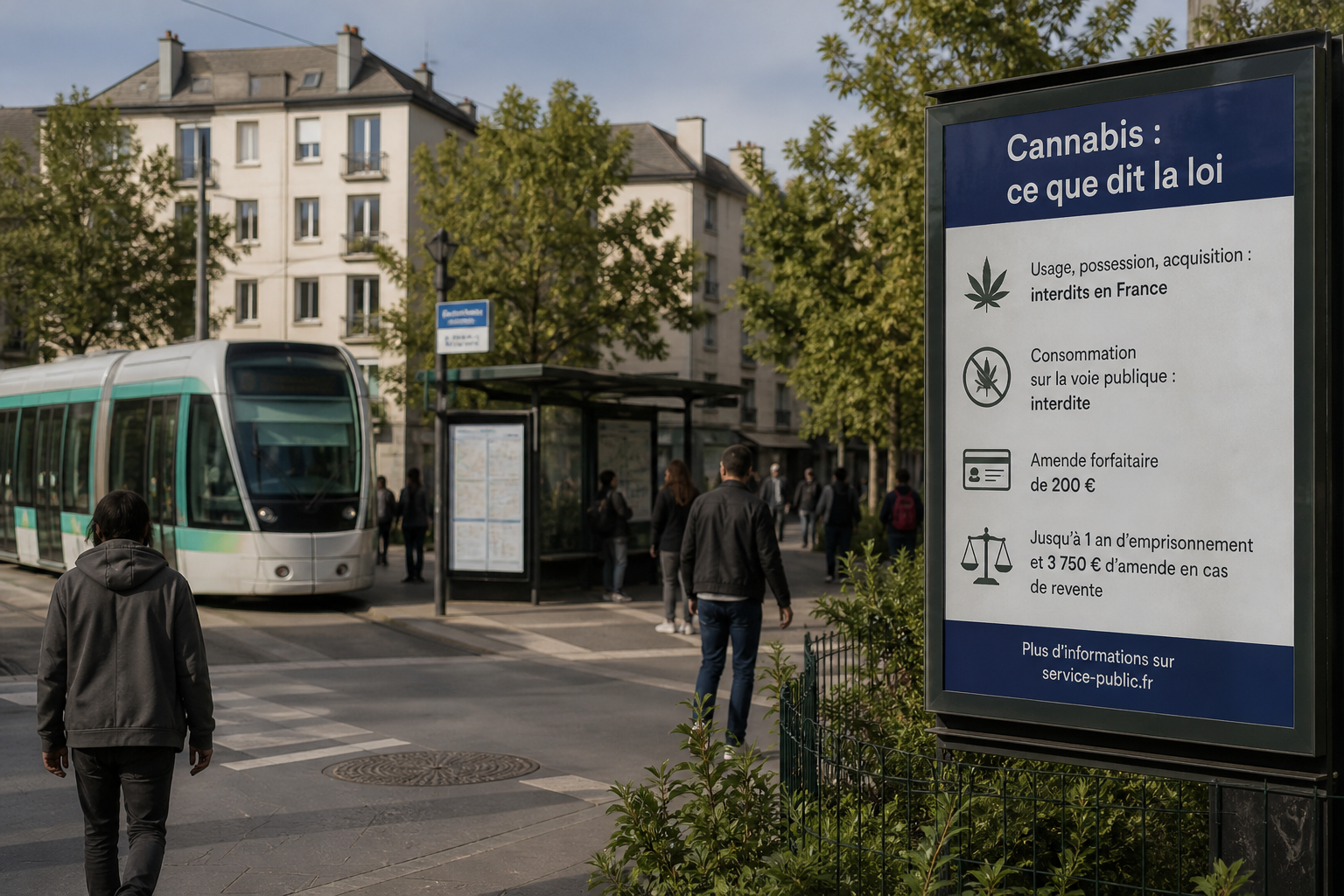
Understanding Cannabis laws and penalties in Épinay-sur-Seine starts with one important point: Épinay-sur-Seine follows French national drug law. The town does not have a separate cannabis market or a local rule that legalises recreational possession, use, purchase or sale. Police checks, court proceedings and fines are therefore governed mainly by the French Public Health Code and related road-traffic rules.
For anyone asking about weed in Épinay-sur-Seine, the practical answer is that recreational cannabis remains illegal. A small amount can still lead to an immediate fine, while circumstances such as repeat offending, supply, driving or possession of a larger quantity may create more serious legal consequences. This guide explains the main rules without treating a local practice or police decision as a guarantee of what will happen in an individual case.
Cannabis laws in Épinay-sur-Seine: the national framework
French law prohibits the unauthorised use, possession, acquisition, transport, cultivation and supply of cannabis containing THC. These rules apply in Épinay-sur-Seine just as they do elsewhere in Seine-Saint-Denis and France. Cannabis is not made lawful merely because it is intended for personal use, kept inside a private home or purchased in another country.
The main legal framework is found in the French Public Health Code. The official text of Article L3421-1 of the Public Health Code sets out the offence of illicit drug use and the associated criminal framework. French authorities also use a fixed-penalty procedure for many straightforward drug-use cases, but that procedure does not turn possession or use into a legal activity.
Does Épinay-sur-Seine have its own cannabis rules?
Municipal authorities may regulate public spaces through general public-order measures, and police can enforce rules concerning nuisance, disorder, smoking restrictions or access to particular places. However, a municipal measure cannot create a general right to possess or consume cannabis. The central issue remains French national law.
This distinction matters when researching cannabis in Épinay-sur-Seine. A person may see different enforcement practices in different settings, but the underlying offence is not different because it occurs near a station, in a residential area, in a park or inside a private property.
Possession and personal use: likely penalties
For a straightforward case involving use or a small quantity, police may issue an amende forfaitaire délictuelle, commonly called a fixed criminal fine. The standard amount is €200. It can be reduced to €150 when paid within the applicable short payment period and increased to €450 if it is not paid on time. The exact payment deadlines and available procedure should be checked on the notice received.
A fixed fine is not the same as decriminalisation. It records a criminal offence and may have consequences beyond the immediate payment, depending on the person’s circumstances and the way official records are handled. It may also be unsuitable for every situation. For example, a case involving disputed facts, a substantial quantity, suspected supply, aggravating factors or a minor may proceed differently.
When can a case become more serious?
French law provides more severe sanctions for conduct beyond simple use. Possession, transport or acquisition may be examined in light of the quantity, packaging, messages, cash, statements and other evidence. A prosecutor may consider whether the facts suggest personal consumption or involvement in supply. Selling, offering, distributing, importing or exporting cannabis carries substantially greater risks than a simple-use case.
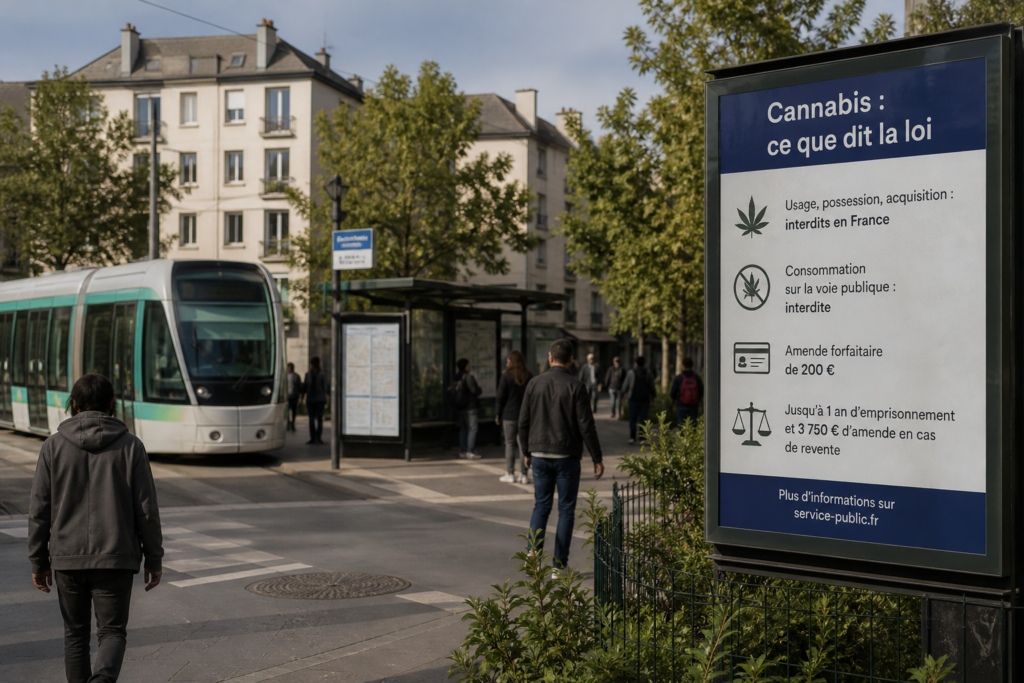
- Personal use: may result in a fixed criminal fine in an eligible straightforward case, or prosecution under the wider criminal provisions.
- Possession or transport: may lead to further investigation, particularly where the quantity or surrounding evidence raises questions about supply.
- Supply or trafficking: can lead to criminal prosecution and much heavier penalties, including imprisonment and substantial fines.
- Cultivation: is not generally permitted for recreational purposes, even when plants are grown privately.
There is no safe “personal amount” that guarantees immunity. Quantity is relevant, but it is not the only factor. The location, conduct, prior history and evidence available to authorities can all affect the outcome.
For a comparison with another municipality in the region, see this practical guide to cannabis possession regulations in Villejuif. The legal principles are national, although individual cases and enforcement circumstances can differ.
Public consumption and possession in Épinay-sur-Seine
Using cannabis in a street, park, building entrance, transport area or other public place can attract police attention and may expose a person to the fixed-fine procedure or prosecution. Public consumption can also create separate issues where it causes disturbance, involves litter, affects other people or occurs near a sensitive location.
Keeping cannabis at home does not make it legal. Private possession may be less visible than public use, but it remains covered by the same national prohibition. Tenants may also face housing or contractual problems if drug-related activity causes damage, nuisance or complaints, even though these are separate from the criminal offence.
Driving after cannabis use
Driving after using cannabis is a particularly serious risk. French road law prohibits driving after using drugs, and enforcement does not depend on a driver feeling impaired. A positive test can lead to criminal proceedings, licence consequences and other sanctions. Combining cannabis with alcohol can make the legal and safety consequences more serious.
Drivers should not assume that waiting until they feel normal makes driving lawful. THC can remain detectable after the noticeable effects have faded, and the timing of detection varies. The safest legal advice is simple: do not drive after using cannabis and arrange another way to travel.
The offence of drug-impaired driving is separate from a possession or use allegation. A person may face consequences for driving even if no cannabis is found in the vehicle. Conversely, finding cannabis in a vehicle can create additional questions about possession, transport or supply.
CBD and low-THC products in Épinay-sur-Seine
CBD products are not automatically treated in the same way as high-THC cannabis, but “CBD” on a label does not guarantee compliance. French and European rules apply to the product’s composition, presentation and intended use. In general, hemp-derived products must remain within the applicable THC limit and meet other regulatory requirements.
The French government information on cannabis and CBD explains that the legal treatment of CBD depends on the product and its THC content. Buyers should check the product category, laboratory information and seller reliability rather than relying only on marketing language.
Practical CBD cautions
- Do not assume that a CBD flower is risk-free in a roadside or workplace test.
- Check that the product complies with the current THC threshold and applicable consumer rules.
- A product labelled “hemp” or “CBD” may still be mislabelled or contaminated.
- Do not carry products across borders without checking the rules of the destination and transit countries.
- Seek medical advice before using CBD with prescription medicines or during pregnancy.
CBD legality does not provide a defence for cannabis containing unlawful levels of THC. It also does not make recreational THC cannabis lawful in Épinay-sur-Seine.
Medical cannabis in Épinay-sur-Seine
Medical cannabis in Épinay-sur-Seine is not the same as buying recreational cannabis from an informal seller. Access to cannabis-based treatment in France has been limited and subject to official medical and regulatory arrangements. A patient should follow the current national framework, use an authorised medical pathway and avoid self-medicating with products of uncertain composition.
A doctor’s advice or a medical condition does not automatically authorise possession of recreational cannabis. Patients travelling with prescribed cannabis-based medicines should carry appropriate documentation and verify transport rules before crossing borders. French rules and the law of another country may differ significantly.
People seeking treatment should discuss evidence-based options with a qualified healthcare professional. They should not drive, work in safety-sensitive roles or alter prescribed medicines without appropriate medical guidance.
Related background is available in this guide to medical cannabis access in Bondy, although readers should still confirm current national arrangements with a healthcare professional or official authority.
What to do after a cannabis stop or fine
If police stop someone in Épinay-sur-Seine, staying calm and avoiding confrontation is important. A person should read any document carefully, check the alleged offence and note the payment deadline. Paying a fine may have legal effects, so anyone who disputes the facts or faces a more serious allegation should obtain advice from a qualified French lawyer promptly.
- Do not provide false information or attempt to destroy evidence.
- Keep the notice, summons or custody documents in a safe place.
- Record the date, location and general circumstances while they are fresh.
- Ask a lawyer about challenge deadlines, court procedure and possible consequences.
- Do not ignore a fine or court notice, because non-payment or non-attendance can worsen the situation.
Visitors and non-French residents should take the matter seriously. A cannabis offence can affect travel plans, immigration questions, driving rights or future dealings with authorities, depending on the facts and the person’s status.
Common misconceptions about cannabis in Épinay-sur-Seine
- “A small quantity is legal.” There is no general personal-use exemption from French law.
- “The fine is only administrative.” The fixed procedure concerns a criminal offence, even when no court hearing takes place.
- “CBD flowers are identical to legal cannabis.” Product composition and compliance are decisive, not the label alone.
- “Private consumption cannot be punished.” Private location does not remove the underlying prohibition.
- “A prescription permits any cannabis product.” Medical authorisation, where applicable, is limited and does not legalise recreational products.
Conclusion
The key points about Cannabis laws and penalties in Épinay-sur-Seine are national rather than municipal. Recreational cannabis remains illegal, a straightforward use case may result in a €200 fixed criminal fine, and possession, supply, cultivation or driving after use can create more serious consequences. CBD products must comply with their own requirements, while medical access depends on the official healthcare framework.
Because procedures and regulations can change, anyone facing a stop, fine, search, summons or driving allegation should consult a qualified French legal professional and verify current information through official government sources. General information cannot replace advice based on the specific facts of an individual case.